Man, I've got to get better about updating this place with links. My review for Paul Morrissey's excellent, transgressive Trash (my first Blindspot entry of the year) has been up for some time at Movie Mezzanine, but I forgot to link to it here. Suffice to say, it's a brilliant, blistering film that also finds an empathy through its actors that the camera otherwise would not communicate. Highly recommended.
My full piece is up at Movie Mezzanine.
|
|
|
|
|
Showing posts with label Blind Spots. Show all posts
Showing posts with label Blind Spots. Show all posts
Tuesday, February 5
Tuesday, January 22
The Long Day Closes (Terence Davies, 1992)
This is my unforgivably late Blind Spots entry for last November. December's pick, Feuillade's Judex, will likely not receive a write-up until next month. However, this month's scheduled Blind Spots piece will appear on time.
The Long Day Closes opens like a classic movie, with the credits appearing before the picture instead of after and playing over a styled image. In this case, it is a still life of some flowers off to the left as credits appear in flowing cursive in the right two-thirds of the screen. When the movie proper begins, it is to the 20th Century Fox fanfare blared over a brick wall with a plaque announcing the film’s setting on Kensington Street. The juxtaposition deftly pre-summarizes the film, in which the still life recreations of postwar Liverpool are enlivened by the joys of cinema that not only give its child protagonist some kind of escape in a dreary community but are internalized and re-emitted to make that world livable.

The boy in question is Bud, an unassuming chap whom Davies regularly places directly in the center of the frame, surrounding him with symmetrical arrangements of people and objects. The dank, dirty brick walls of this industrial port town lend the film shades of neo-realism, but as with the more brutally forthright Distant Voices, Still Lives, such mise-en-scène adds a lyrical, formal quality to what might have been kitchen-sink aesthetics. The falsity of the image is blatant, but that also informs so much of the film’s deeply felt approach to memory.
Where so many films use a child’s perspective as an “out” for narrative and thematic responsibility, an excuse for perpetuating immature and facile understandings of the complexity of life by rooting them in immature characters, Davies’ semi-autobiographical reminiscence actually attempts to root the film’s aesthetic qualities in that same perspective. Instead reveling in “realistic” visions of horror and struggle while sidestepping their more complex implications, Davies reflects Bud’s cinematic escape fantasies into even the most straightforward frame. Flourishes of camera movement and vividly classical lighting setups serve not only as glimpses into a child’s compartmentalization of the traumas of restrictive British life but as signifiers of the subjective nature of memory, which exaggerates both the fond and not-so-fond events of one’s life.
As the movie lacks any real narrative, what sticks in the mind most are the moments in themselves. The imposing vastness of the Catholic church where Bud is dragged is made terrifyingly small in an intense sequence where the imposed guilt of Catholicism manifests itself via the Christ carved into the church’s crucifix becomes flesh once more before Bud’s terrified eyes. (As a vision of the lingering immediacy of Catholic dogma on the malleable mind and spirit of a child, this section recalls a similar sequence made more recently in the “God” episode of Louie.) At school, Bud finds ways to tune out bullying peers and abusive teachers, such as in one beautiful scene where Davies spotlights the boy (in center-frame, natch) and fades out the rest of the class into near-darkness as Bud daydreams a great ship rolling on the waves of the sea. Davies cuts to this ship, then back to Bud as ocean spray dots his face, dissolving the sudden leap in space and time in such a way that the stately compositions become as thrilling as the most acrobatic camerawork seen elsewhere. Of course, there are also moments that linger in the memory for their extreme banality, such as a static medium-long shot of boys lining up for a lice check, the sort of thing that not even the wildest imagination could make fantastical.
The word “impressionable” tends to be used only in a negative context, as in susceptible to whatever ills a socially conservative (or liberal) activist sees in pop culture. Yet Davies’ presents Bud’s impressionability to the films he sees with fondness and nostalgia. The beam that isolates Bud in the aforementioned classroom shot is soon matched by the projector beam flicking above his balcony seat at the theater, and it is important to note that, until the last shot of the film, Davies never privileges the audience with what Bud watches when he goes to the movies. Instead, the sounds of familiar music and dialogue filter through the audio track as Bud, like any cinephile, cannot help but think of his favorite movies in everyday life. For all the film’s stylistic beauty, nothing captures its approach to the movies and memory like a shot of a young couple whose conversation is replaced by dialogue from Meet Me in St. Louis, their spied-upon young love taking on decidedly cinematic overtones as their bashful, natural chat becomes florid romance capped by an opaque stained glass door closing on them, silhouetting their faces as they move in to each other. In a flash, real life and Minnelli are one and the same, and the joys of both are deepened in new and exciting ways.
The Long Day Closes opens like a classic movie, with the credits appearing before the picture instead of after and playing over a styled image. In this case, it is a still life of some flowers off to the left as credits appear in flowing cursive in the right two-thirds of the screen. When the movie proper begins, it is to the 20th Century Fox fanfare blared over a brick wall with a plaque announcing the film’s setting on Kensington Street. The juxtaposition deftly pre-summarizes the film, in which the still life recreations of postwar Liverpool are enlivened by the joys of cinema that not only give its child protagonist some kind of escape in a dreary community but are internalized and re-emitted to make that world livable.

The boy in question is Bud, an unassuming chap whom Davies regularly places directly in the center of the frame, surrounding him with symmetrical arrangements of people and objects. The dank, dirty brick walls of this industrial port town lend the film shades of neo-realism, but as with the more brutally forthright Distant Voices, Still Lives, such mise-en-scène adds a lyrical, formal quality to what might have been kitchen-sink aesthetics. The falsity of the image is blatant, but that also informs so much of the film’s deeply felt approach to memory.
Where so many films use a child’s perspective as an “out” for narrative and thematic responsibility, an excuse for perpetuating immature and facile understandings of the complexity of life by rooting them in immature characters, Davies’ semi-autobiographical reminiscence actually attempts to root the film’s aesthetic qualities in that same perspective. Instead reveling in “realistic” visions of horror and struggle while sidestepping their more complex implications, Davies reflects Bud’s cinematic escape fantasies into even the most straightforward frame. Flourishes of camera movement and vividly classical lighting setups serve not only as glimpses into a child’s compartmentalization of the traumas of restrictive British life but as signifiers of the subjective nature of memory, which exaggerates both the fond and not-so-fond events of one’s life.
As the movie lacks any real narrative, what sticks in the mind most are the moments in themselves. The imposing vastness of the Catholic church where Bud is dragged is made terrifyingly small in an intense sequence where the imposed guilt of Catholicism manifests itself via the Christ carved into the church’s crucifix becomes flesh once more before Bud’s terrified eyes. (As a vision of the lingering immediacy of Catholic dogma on the malleable mind and spirit of a child, this section recalls a similar sequence made more recently in the “God” episode of Louie.) At school, Bud finds ways to tune out bullying peers and abusive teachers, such as in one beautiful scene where Davies spotlights the boy (in center-frame, natch) and fades out the rest of the class into near-darkness as Bud daydreams a great ship rolling on the waves of the sea. Davies cuts to this ship, then back to Bud as ocean spray dots his face, dissolving the sudden leap in space and time in such a way that the stately compositions become as thrilling as the most acrobatic camerawork seen elsewhere. Of course, there are also moments that linger in the memory for their extreme banality, such as a static medium-long shot of boys lining up for a lice check, the sort of thing that not even the wildest imagination could make fantastical.
The word “impressionable” tends to be used only in a negative context, as in susceptible to whatever ills a socially conservative (or liberal) activist sees in pop culture. Yet Davies’ presents Bud’s impressionability to the films he sees with fondness and nostalgia. The beam that isolates Bud in the aforementioned classroom shot is soon matched by the projector beam flicking above his balcony seat at the theater, and it is important to note that, until the last shot of the film, Davies never privileges the audience with what Bud watches when he goes to the movies. Instead, the sounds of familiar music and dialogue filter through the audio track as Bud, like any cinephile, cannot help but think of his favorite movies in everyday life. For all the film’s stylistic beauty, nothing captures its approach to the movies and memory like a shot of a young couple whose conversation is replaced by dialogue from Meet Me in St. Louis, their spied-upon young love taking on decidedly cinematic overtones as their bashful, natural chat becomes florid romance capped by an opaque stained glass door closing on them, silhouetting their faces as they move in to each other. In a flash, real life and Minnelli are one and the same, and the joys of both are deepened in new and exciting ways.
Tuesday, January 1
Blindspots 2013
It may be presumptuous of me to plan for another year's worth of Blindspots posts when I still have two more from 2012 to complete (expect one for The Long Day Closes within a week and Judex...well, later). Still, these are some films I've meant to watch for some time, so perhaps writing them down here will prompt me to get to them. As with last year, I'll cover one a month at random (save for the horror film meant for October). The films are as follows:
All That Jazz (Bob Fosse, 1979)
By the Bluest of Seas (Boris Barnet, 1936)
Duelle (Jacques Rivette, 1976)
Elephant (Gus Van Sant, 2003)
French Cancan (Jean Renoir, 1955)
Gertrud (Carl Theodor Dreyer, 1964)
The Long Goodbye (Robert Altman, 1973)
Suspiria (Dario Argento, 1977)
Too Early, Too Late (Jean-Marie Straub and Danièle Huillet, 1982)
Trash (Paul Morrisey, 1970)
Ugetsu (Kenji Mizoguchi, 1953)
The Umbrellas of Cherbourg (Jacques Demy, 1964)
Tuesday, December 4
There's Always Tomorrow (Douglas Sirk, 1956)
[The following is my belated October entry for Blind Spots. I hope to catch up on last months and watch my final pick for the year on time.]
 Clifford Groves (Fred MacMurray) has made a life of modest prosperity for himself. He has built a reasonably sized toy manufacturer from the ground up, offering him enough affluence to afford a nice house and a servant to help around it. Unlike Douglas Sirk’s “women’s pictures,” There’s Always Tomorrow remains with Cliff, who, in darkly amusing irony, is everything the husbands in those other melodramas is not. A decent, hard worker and a loving family man, Cliff is not the tyrant of his household but the ideal vision of the postwar American man. And yet, he exists in a prison as much the housewives who dot typical domestic dramas from the period, caged not by abuse but neglect, objectified not as a provider of care but of material sustenance.
Sirk inverts the usual dynamics of melodrama to tell Cliff’s story. The director wanted to shoot the movie in color but could not secure the money to do so. Nevertheless, Russell Metty’s black-and-white cinematography visualizes the different social pressures and archetypes at work on men. The emotive, visceral use of color is thus swapped for a kind of remove, denying Cliff an aesthetic outlet for his feelings to ensure he does not have any unmanly outbursts. Deep focus shots capture the vastness of the home’s interiors, and the cold space they create emphasizes how stark and dead the middle-class comfort around the man has become.
Most would say that the impetus for Cliff’s sudden reflection and dissatisfaction with his life comes when an old coworker, Norma (Barbara Stanwyck), knocks on his door one night. But the seeds of Cliff’s awakening are planted just before, by some show tickets he traverses through rain to acquire for his wife, Marion (Joan Bennett). Pleased with himself, Cliff returns home only for Marion to say she has to attend a recital and cannot back out of the engagement. Mildly dejected, Cliff tries to get one of the kids to come along, but everyone turns him down. Even the damn maid cannot go, and soon Cliff is left alone to fix his dinner and answer that fateful knock.
Yet the tickets remain meaningful even after Norma shows up, for they foretell the outcome of this brief injection of life into Cliff’s routine. The toymaker is thrilled to see his colleague, more still when he can finally use those tickets. Almost as soon as Cliff merrily settles into his seat, happy the tickets will not go to waste, Norma confesses she already saw the show back home in New York and would rather see his factory to see what he has been up to. The moment crystallizes Norma’s hidden feelings for Cliff, a desire to truly spend time with him and perhaps rekindle feelings. (No, kindle, for he never felt that way about her.) Yet her casual dismissal of Cliff’s desire to attend the show and use the tickets he had to go all over town to get points to even Norma selfishly using Cliff to her own ends. Cliff’s shifted, mundane priorities, evidenced by his simple desire to go to the theatre, hint at the fundamental futility of the fanciful thoughts of running away with Norma that gradually enter his head as she offers an alternative to such deflated goals.
The film further communicates the certainty of this flame’s futility through its very casting. In their fourth and final pairing, MacMurray and Stanwyck show a bit of their age. Neither was ever glamorous, but here even their twists on their Every(wo)man appearances — MacMurray’s penchant for being led astray from his father-figure wholesomeness, Stanwyck as the ultimate temptress — have been muted by age. Now, Norma is only tempting in her presence, not the sort of predatory conquest Stanwyck visited upon her hapless targets (including MacMurray himself in Double Indemnity), and the extent of temptation that Cliff feels is merely for an escape from his routine.
Sirk employs some of his trademark visual tics throughout: tilted angles mingle with the slanted walls of the toy factory to hint at a stylized trap, while the aforementioned home interiors use the extra space to create a contradictory sense of imprisonment. Yet the film lacks much of the visual passion and erotic charge of his color melodramas; even the “romance” is hardly so, and it certainly stops well before the affair Cliff’s children come to suspect their father of having. Their sneaky whispering proves just how dehumanized Cliff is: no one bothers to ask him who this woman is on their way to spreading rumors among themselves. The film does not play on the idea that the patriarchy no longer holds power, merely that it has dessicated those whom it benefits, making the king of the house as unapproachable and abstract as any other monarch. The world is not aligned against Cliff the way it might have been for his wife in another movie, but even the patriarchy has been subjugated under the American Dream, and its attainment is laid bare as a hollow accomplishment that dehumanizes instead of bringing happiness.

Sirk inverts the usual dynamics of melodrama to tell Cliff’s story. The director wanted to shoot the movie in color but could not secure the money to do so. Nevertheless, Russell Metty’s black-and-white cinematography visualizes the different social pressures and archetypes at work on men. The emotive, visceral use of color is thus swapped for a kind of remove, denying Cliff an aesthetic outlet for his feelings to ensure he does not have any unmanly outbursts. Deep focus shots capture the vastness of the home’s interiors, and the cold space they create emphasizes how stark and dead the middle-class comfort around the man has become.
Most would say that the impetus for Cliff’s sudden reflection and dissatisfaction with his life comes when an old coworker, Norma (Barbara Stanwyck), knocks on his door one night. But the seeds of Cliff’s awakening are planted just before, by some show tickets he traverses through rain to acquire for his wife, Marion (Joan Bennett). Pleased with himself, Cliff returns home only for Marion to say she has to attend a recital and cannot back out of the engagement. Mildly dejected, Cliff tries to get one of the kids to come along, but everyone turns him down. Even the damn maid cannot go, and soon Cliff is left alone to fix his dinner and answer that fateful knock.
Yet the tickets remain meaningful even after Norma shows up, for they foretell the outcome of this brief injection of life into Cliff’s routine. The toymaker is thrilled to see his colleague, more still when he can finally use those tickets. Almost as soon as Cliff merrily settles into his seat, happy the tickets will not go to waste, Norma confesses she already saw the show back home in New York and would rather see his factory to see what he has been up to. The moment crystallizes Norma’s hidden feelings for Cliff, a desire to truly spend time with him and perhaps rekindle feelings. (No, kindle, for he never felt that way about her.) Yet her casual dismissal of Cliff’s desire to attend the show and use the tickets he had to go all over town to get points to even Norma selfishly using Cliff to her own ends. Cliff’s shifted, mundane priorities, evidenced by his simple desire to go to the theatre, hint at the fundamental futility of the fanciful thoughts of running away with Norma that gradually enter his head as she offers an alternative to such deflated goals.
The film further communicates the certainty of this flame’s futility through its very casting. In their fourth and final pairing, MacMurray and Stanwyck show a bit of their age. Neither was ever glamorous, but here even their twists on their Every(wo)man appearances — MacMurray’s penchant for being led astray from his father-figure wholesomeness, Stanwyck as the ultimate temptress — have been muted by age. Now, Norma is only tempting in her presence, not the sort of predatory conquest Stanwyck visited upon her hapless targets (including MacMurray himself in Double Indemnity), and the extent of temptation that Cliff feels is merely for an escape from his routine.
Sirk employs some of his trademark visual tics throughout: tilted angles mingle with the slanted walls of the toy factory to hint at a stylized trap, while the aforementioned home interiors use the extra space to create a contradictory sense of imprisonment. Yet the film lacks much of the visual passion and erotic charge of his color melodramas; even the “romance” is hardly so, and it certainly stops well before the affair Cliff’s children come to suspect their father of having. Their sneaky whispering proves just how dehumanized Cliff is: no one bothers to ask him who this woman is on their way to spreading rumors among themselves. The film does not play on the idea that the patriarchy no longer holds power, merely that it has dessicated those whom it benefits, making the king of the house as unapproachable and abstract as any other monarch. The world is not aligned against Cliff the way it might have been for his wife in another movie, but even the patriarchy has been subjugated under the American Dream, and its attainment is laid bare as a hollow accomplishment that dehumanizes instead of bringing happiness.
Monday, October 1
Center Stage (Stanley Kwan, 1992)
[The following is my Blind Spots review for September]
 Using period-appropriate filming techniques for movies set in the 20th century is hardly new, especially in the use of melodramatic lighting and color. But Stanley Kwan's Center Stage (a.k.a. Actress) actually incorporates the techniques into the film at hand, the biopic of 1930s star Ruan Ling-yu doubling as a recreation of both period-appropriate Chinese melodrama and the postwar American melodrama as practiced by Sirk, Ray et al. By going outside the stylistic touches of the film's time to broadly canvas melodrama as a fluid, evolving, international artform and expression. As if to to prove to the audience why they should care for the film's subject, Kwan establishes the artistic worth of the medium and genre in which she worked.
Yet this also sets the stage for Kwan to show how the films in which Ruan gained her fame—tales of harassed and martyred women misunderstood and abused by social forces and an ignorant mob—were reflected in the tragedy of her short life. Her penultimate film, New Women, portrayed the press as an insensitive pack of jackals who drove a women to her suicide, an outrage that prompted vindictive newspapers to...drive this woman to her suicide. It is a twisted irony, and the director adds a layer of his own by including black-and-white scenes of himself and the actors as themselves, discussing their "characters" and interviewing surviving members of the Chinese film industry who worked with the actress. The film's first scene depicts Kwan explaining Ruan's career arc, which began with minor roles in fluff before she went to a film studio that prided itself on more progressive, artistic work and her career exploded. Maggie Cheung, who plays Ruan, notes with a laugh that her own path recalls Ruan. In another case of life imitating art, Cheung would use this very part to transition from supporting roles to becoming one of the most respected actresses on the international stage. When making a film biography of a film star, one supposes that self-reflexivity is unavoidable.
The shift to color when Center Stage moves into the past floods the screen with golden light, radiant reds and the cool blues of Technicolor night. Seemingly everything is a reflective surface, the ascendant star always surrounded by twinkles of brilliant light. Yet as with so many melodramas, all that florid beauty serves as a cage for the protagonist, who finds herself restricted not only by the sudden, overwhelming fame that falls on her young shoulders but by the male-dominated system that exploits her to cast a bitterly ironic image of a progressive studio. Kwan shows the shooting of Ruan's most famous films from behind the scenes, his color stock picking up the extra makeup pancaked onto actors's faces for the black-and-white silents, the male directors calling out from behind the camera to give Ruan instructions during a shot. As a symbol for the Lianhua Film Company, Ruan and her bevy of impoverished, sacrificial prostitutes and workers put them at the forefront of class-conscious filmmaking, yet the audience for Center Stage sees all the strings attached to the marionettes.
Nevertheless, Kwan and Cheung do show Ruan's talent as an actress. Where the men on-set tend to give pointers through a simplistic recap of how the character feels as a result of what has happened to her, Ruan can actually empathize with the characters set up as props for the studio's pro-Communist viewpoints. On the set of Little Toys, she coaches her costar, Li Lili (Carina Lau), by succinctly and eloquently guiding the other actress to truly picturing the scene as it affects their characters. So skilled is Ruan at inhabiting her characters that her youth—she did not live to see her 25th birthday—feels irrelevant to the maturity and dignity with which she imbues her roles. In Little Toys, for example, Lili's character in question is Ruan's 17-year-old daughter. But Cheung and Lau play the actresses as taking it as seriously as the real people appear to be in the clips of the actual Little Toys Kwan includes in the film. Throughout, Cheung plays Ruan not as a wide-eyed girl off the bus who finds herself swept up in stardom but an intelligent woman who knows full well that her entire professional life is being decided by studio executives who want her to always be "the next ______," the new big thing who will one day be thrown out when she is "too old" at 30. Likewise, Ruan is aware she must work overtime to make sure the details of her chaotic personal life never escape closed doors lest it destroy. And when, in the wake of New Women's disastrous press screening, she looks in a newspaper and sees headlines about her affair, her scream sounds like that of a mother who lost her child. She knows in an instant what this means, and she cannot cope with it.
Soon, Ruan would be dead, immortalizing her as an icon in China but also preventing her from working into an era with more consistent film preservation. As if to further complicate her mythic status, so many of the films she made are now lost, as explained by intertitles Kwan places over stills and surviving reels of those movies. That the film partially "recreates" those movies by showing their production adds a metacinematic element to its reconstruction of the star's life by rebuilding the work that, in many cases, no longer exists. In the climax, Kwan waves together real images of Ruan's funeral with Cheung posed for the same, but he also contrasts his sets standing in for Lianhua studios for the real thing, in disrepair at the time of filming. The studio fell into decline after Ruan's death, largely because of the escalating war with the Japanese. But Kwan turns this into a final melodramatic flourish, the actress' demise turned into a final revenge upon the company that used her by turning the tide in their fortunes. In her films, Ruan symbolizes the injustices of society; as an avatar, she comes to stand for the injustices within the industry that claimed to take a stand against them. In other words, it is an awards-ready film about the fraudulent and hypocritical nature of so many awards-ready films.

Yet this also sets the stage for Kwan to show how the films in which Ruan gained her fame—tales of harassed and martyred women misunderstood and abused by social forces and an ignorant mob—were reflected in the tragedy of her short life. Her penultimate film, New Women, portrayed the press as an insensitive pack of jackals who drove a women to her suicide, an outrage that prompted vindictive newspapers to...drive this woman to her suicide. It is a twisted irony, and the director adds a layer of his own by including black-and-white scenes of himself and the actors as themselves, discussing their "characters" and interviewing surviving members of the Chinese film industry who worked with the actress. The film's first scene depicts Kwan explaining Ruan's career arc, which began with minor roles in fluff before she went to a film studio that prided itself on more progressive, artistic work and her career exploded. Maggie Cheung, who plays Ruan, notes with a laugh that her own path recalls Ruan. In another case of life imitating art, Cheung would use this very part to transition from supporting roles to becoming one of the most respected actresses on the international stage. When making a film biography of a film star, one supposes that self-reflexivity is unavoidable.
The shift to color when Center Stage moves into the past floods the screen with golden light, radiant reds and the cool blues of Technicolor night. Seemingly everything is a reflective surface, the ascendant star always surrounded by twinkles of brilliant light. Yet as with so many melodramas, all that florid beauty serves as a cage for the protagonist, who finds herself restricted not only by the sudden, overwhelming fame that falls on her young shoulders but by the male-dominated system that exploits her to cast a bitterly ironic image of a progressive studio. Kwan shows the shooting of Ruan's most famous films from behind the scenes, his color stock picking up the extra makeup pancaked onto actors's faces for the black-and-white silents, the male directors calling out from behind the camera to give Ruan instructions during a shot. As a symbol for the Lianhua Film Company, Ruan and her bevy of impoverished, sacrificial prostitutes and workers put them at the forefront of class-conscious filmmaking, yet the audience for Center Stage sees all the strings attached to the marionettes.
Nevertheless, Kwan and Cheung do show Ruan's talent as an actress. Where the men on-set tend to give pointers through a simplistic recap of how the character feels as a result of what has happened to her, Ruan can actually empathize with the characters set up as props for the studio's pro-Communist viewpoints. On the set of Little Toys, she coaches her costar, Li Lili (Carina Lau), by succinctly and eloquently guiding the other actress to truly picturing the scene as it affects their characters. So skilled is Ruan at inhabiting her characters that her youth—she did not live to see her 25th birthday—feels irrelevant to the maturity and dignity with which she imbues her roles. In Little Toys, for example, Lili's character in question is Ruan's 17-year-old daughter. But Cheung and Lau play the actresses as taking it as seriously as the real people appear to be in the clips of the actual Little Toys Kwan includes in the film. Throughout, Cheung plays Ruan not as a wide-eyed girl off the bus who finds herself swept up in stardom but an intelligent woman who knows full well that her entire professional life is being decided by studio executives who want her to always be "the next ______," the new big thing who will one day be thrown out when she is "too old" at 30. Likewise, Ruan is aware she must work overtime to make sure the details of her chaotic personal life never escape closed doors lest it destroy. And when, in the wake of New Women's disastrous press screening, she looks in a newspaper and sees headlines about her affair, her scream sounds like that of a mother who lost her child. She knows in an instant what this means, and she cannot cope with it.
Soon, Ruan would be dead, immortalizing her as an icon in China but also preventing her from working into an era with more consistent film preservation. As if to further complicate her mythic status, so many of the films she made are now lost, as explained by intertitles Kwan places over stills and surviving reels of those movies. That the film partially "recreates" those movies by showing their production adds a metacinematic element to its reconstruction of the star's life by rebuilding the work that, in many cases, no longer exists. In the climax, Kwan waves together real images of Ruan's funeral with Cheung posed for the same, but he also contrasts his sets standing in for Lianhua studios for the real thing, in disrepair at the time of filming. The studio fell into decline after Ruan's death, largely because of the escalating war with the Japanese. But Kwan turns this into a final melodramatic flourish, the actress' demise turned into a final revenge upon the company that used her by turning the tide in their fortunes. In her films, Ruan symbolizes the injustices of society; as an avatar, she comes to stand for the injustices within the industry that claimed to take a stand against them. In other words, it is an awards-ready film about the fraudulent and hypocritical nature of so many awards-ready films.
Tuesday, July 31
Some Came Running (Vincente Minnelli, 1958)
[The following is my July entry for Blind Spots.]
 Some Came Running opens with antithetical moods. Lush but subtle color paints the bus ride of a soldier returning from World War II in warmth, a gentle portrait of the prodigal son on his journey back home. But the CinemaScope framing and portentous music from Elmer Bernstein undercuts this sense of idyll, inserting a sense of tension and conflict before anything has happened. The incongruity of these moods instantly undermines any audience expectation and generating a level of uncertainty in what will follow. For another filmmaker, such unsure footing might be the sign of weak technique and structure, but Vincente Minnelli ingeniously sets to undermining his own frame before he's put anything of note into it.
Soon, the tension becomes clear. The bus driver wakes the soldier, Dave Hirsh (Frank Sinatra), whose grogginess turns to sober apprehension when he learns he has been brought back to his hometown. When he gets off the bus, a ditzy Chicago girl, Ginny (Shirley MacLaine), gets off with him, mentioning how he was so good as to rough up her abusive boyfriend back in Chicago and bring her along. Dave's bewilderment over her, and his clearly unwelcome return home, reveal that this ostensibly happy moment is the result of a night of blackout drinking. As Dave puts up in a nearby hotel until he can figure out what to do, he finds himself drawn into a world dictated by insipid proprietary norms and both undercut and fundamentally supported by a vulgar underground.
Dave's reluctance to come back to Parkman stems from his brother, Frank (Arthur Kennedy), who tossed his brother into a boarding school when they were young so he could go off and live his own life. In the interim, Dave wrote some novels that went over like lead zeppelins and joined the military. Meanwhile, Frank married, got rich and became a respected member of the community. When Minnelli moves away from Dave's outrage at being within 50 miles of his brother to the brother himself, he clarifies Some Came Running as a work of sly suburban satire. For if Dave reacts to being in Parkman with anger and resentment, Frank responds to his brother's return with barely concealed panic, freezing with a sunken stomach when one of his customers in the jewelry store jovially tells him the good news.
Whether intentionally or not, Dave soon proves his brother's fears of social embarrassment founded. With Ginny often in tow, Dave finds the cracks in this postwar, middle-class heaven and sinks into a seedy underworld of booze and carousing. Dave pairs up with a local drunk, Dillert (Dean Martin), a card sharp hellion who drifted his way to Parkman and stayed because something caught his eye. Perhaps, in his stupor, Dillert saw past the mirage and got a gander of the underbelly teeming around all the small town conservatism and social climbing. His overt loutishness, though not romanticized, is preferable to the composed behavior of Frank and his wife, Agnes (Leora Dana). At least Dillert is honest in his Dionysian irascibility. In the surface world, David goes to meet with his brother and the sister-in-law who resents him for writing an unflattering character in one of his books based on her. But before Dave arrives, Minnelli eavesdrops on the couple as they prepare for him. Agnes rails viciously against Dave for his social slight, and the hollow smile and pleasantries she foists on her husband's abandoned brother when he does show up are made that much more false and vile for showing the petty anger they thinly mask.
One of the most striking elements of Meet Me in St. Louis, Minnelli's great 1944 musical, was its patience, its willingness to simply ingratiate itself with its central family without introducing conflict until late in the film. The tensions in Some Came Running are more immediately apparent, yet the director displays the same relaxed sense of narrative pace. The juxtapositions of Dave's bitter forthrightness and Frank's social posturing, and of the two distinct yet connected worlds they represent, do not produce enough conflict on their own to propel a narrative. Instead, Minnelli allows a mood to build, one of characters trapped in a constricting society, even (and especially) those who see themselves as outside it.
As the narrative takes a great deal of time to unfold, Minnelli communicates primarily through his direction. Famous for his florid use of color, Minnelli tones down the brightness of this movie, casting the frame in more subdued tones that link the façade of bourgeois comfort and success with the dim underworld where Dave spends so much of his time. His fondness for framing interiors in sharp diagonals likewise generates vague, subconscious uncertainty. Not as outlandish as some other '50s melodramas that dug under the skin of postwar conformism, Some Came Running nevertheless feels most like the precursor of David Lynch's postmodern forays into the surreally stylized dark heart of suburbia. Some Came Running especially shares Lynch's conviction that the unseemly pits of thugs and outsiders are not an outlying manifestation of a "normal" community but that such normalcy is the outgrowth of that monstrous realm looking to disguise itself.
Gradually, Minnelli strings out the faintest burbles of trouble. The audience gets a few pointed references to Frank's loyal—too loyal?—secretary; the loose love triangle of Ginny's unreciprocated feelings for Dave and Dave's unrequited affection for Gwen (Martha Hyer), the schoolteacher who admires Dave's writing but finds him a repulsive human being; and the emergence of Ginny's gangster boyfriend. Yet these details do not suddenly turn the film into a plot-driven vehicle, instead serving to flesh out the character dynamics and the overall sense of discontent and hypocrisy. Only at the end, in a vivid carnival sequence that acts as a showcase for the possibilities of CinemaScope, do the wisps of plot converge in a gut-wrenching finale all the more horrific for being sudden yet, in retrospect, justified.
As much as Minnelli's aesthetic perfectionism guides the film, he allows the actors to truly sell these beats of social malaise and, finally, tragedy. Sinatra transfigures his eternal rakishness into defeatism, his natural cool and defiance still intact as Dave but perverted from hip loner to just lonely. When Frank makes a half-assed, condemning remark to his brother that he wishes he could say he was sorry, Sinatra places the perfect blend of contempt and regret in his reply, "Yeah, I wish you could, too." Martin, fresh off his split with Jerry Lewis, plays his typed role as the heavy drinker, but he displays his character's richness in only a few choicely parsed phrases that speak to the benign stubbornness that motivates the good-natured vulgarian.
Best and most affecting of all is MacLaine, who plays her character as emotional collateral damage to the petty bickering of the film's small conflicts well before she becomes the literal collateral damage in the final burst of true danger. MacLaine holds nothing back, not checking Ginny's airiness so that when we get to see the way Dave treats her, the revelation that he never treated her nicely, that the poor girl just cannot understand even the most obvious, withering sarcasm, cannot be seen as surprising even as to see it turns the stomach. In the film's rawest scene, Ginny, at last fed up with her own cluelessness, goes to visit Gwen and practically begs the other woman to just make sense of Dave. Her blunt, ragged pain tears through Gwen's propriety and moral superiority, undermining the safety and illusion of the social game everyone in Parkman plays better than anything Minnelli does with the camera. So radical is her unpretentious, unvarnished honesty that she breaks from the suffocating surroundings where no one else can, and it is not for nothing that the seemingly loose girl who arrived in garish colors at the start of the film ends wearing virginal white in the explosion of Technicolor around her. Dave worried that the town would not accept her when they got off the bus, and he was right, but only because she represents all the innocence none of them have, and as such her moral break from the morass around her must soon be followed by a horrifying physical departure that eradicates the sole gleam of hope and humanity in either of Parkman's parallel worlds.

Soon, the tension becomes clear. The bus driver wakes the soldier, Dave Hirsh (Frank Sinatra), whose grogginess turns to sober apprehension when he learns he has been brought back to his hometown. When he gets off the bus, a ditzy Chicago girl, Ginny (Shirley MacLaine), gets off with him, mentioning how he was so good as to rough up her abusive boyfriend back in Chicago and bring her along. Dave's bewilderment over her, and his clearly unwelcome return home, reveal that this ostensibly happy moment is the result of a night of blackout drinking. As Dave puts up in a nearby hotel until he can figure out what to do, he finds himself drawn into a world dictated by insipid proprietary norms and both undercut and fundamentally supported by a vulgar underground.
Dave's reluctance to come back to Parkman stems from his brother, Frank (Arthur Kennedy), who tossed his brother into a boarding school when they were young so he could go off and live his own life. In the interim, Dave wrote some novels that went over like lead zeppelins and joined the military. Meanwhile, Frank married, got rich and became a respected member of the community. When Minnelli moves away from Dave's outrage at being within 50 miles of his brother to the brother himself, he clarifies Some Came Running as a work of sly suburban satire. For if Dave reacts to being in Parkman with anger and resentment, Frank responds to his brother's return with barely concealed panic, freezing with a sunken stomach when one of his customers in the jewelry store jovially tells him the good news.
Whether intentionally or not, Dave soon proves his brother's fears of social embarrassment founded. With Ginny often in tow, Dave finds the cracks in this postwar, middle-class heaven and sinks into a seedy underworld of booze and carousing. Dave pairs up with a local drunk, Dillert (Dean Martin), a card sharp hellion who drifted his way to Parkman and stayed because something caught his eye. Perhaps, in his stupor, Dillert saw past the mirage and got a gander of the underbelly teeming around all the small town conservatism and social climbing. His overt loutishness, though not romanticized, is preferable to the composed behavior of Frank and his wife, Agnes (Leora Dana). At least Dillert is honest in his Dionysian irascibility. In the surface world, David goes to meet with his brother and the sister-in-law who resents him for writing an unflattering character in one of his books based on her. But before Dave arrives, Minnelli eavesdrops on the couple as they prepare for him. Agnes rails viciously against Dave for his social slight, and the hollow smile and pleasantries she foists on her husband's abandoned brother when he does show up are made that much more false and vile for showing the petty anger they thinly mask.
One of the most striking elements of Meet Me in St. Louis, Minnelli's great 1944 musical, was its patience, its willingness to simply ingratiate itself with its central family without introducing conflict until late in the film. The tensions in Some Came Running are more immediately apparent, yet the director displays the same relaxed sense of narrative pace. The juxtapositions of Dave's bitter forthrightness and Frank's social posturing, and of the two distinct yet connected worlds they represent, do not produce enough conflict on their own to propel a narrative. Instead, Minnelli allows a mood to build, one of characters trapped in a constricting society, even (and especially) those who see themselves as outside it.
As the narrative takes a great deal of time to unfold, Minnelli communicates primarily through his direction. Famous for his florid use of color, Minnelli tones down the brightness of this movie, casting the frame in more subdued tones that link the façade of bourgeois comfort and success with the dim underworld where Dave spends so much of his time. His fondness for framing interiors in sharp diagonals likewise generates vague, subconscious uncertainty. Not as outlandish as some other '50s melodramas that dug under the skin of postwar conformism, Some Came Running nevertheless feels most like the precursor of David Lynch's postmodern forays into the surreally stylized dark heart of suburbia. Some Came Running especially shares Lynch's conviction that the unseemly pits of thugs and outsiders are not an outlying manifestation of a "normal" community but that such normalcy is the outgrowth of that monstrous realm looking to disguise itself.
Gradually, Minnelli strings out the faintest burbles of trouble. The audience gets a few pointed references to Frank's loyal—too loyal?—secretary; the loose love triangle of Ginny's unreciprocated feelings for Dave and Dave's unrequited affection for Gwen (Martha Hyer), the schoolteacher who admires Dave's writing but finds him a repulsive human being; and the emergence of Ginny's gangster boyfriend. Yet these details do not suddenly turn the film into a plot-driven vehicle, instead serving to flesh out the character dynamics and the overall sense of discontent and hypocrisy. Only at the end, in a vivid carnival sequence that acts as a showcase for the possibilities of CinemaScope, do the wisps of plot converge in a gut-wrenching finale all the more horrific for being sudden yet, in retrospect, justified.
As much as Minnelli's aesthetic perfectionism guides the film, he allows the actors to truly sell these beats of social malaise and, finally, tragedy. Sinatra transfigures his eternal rakishness into defeatism, his natural cool and defiance still intact as Dave but perverted from hip loner to just lonely. When Frank makes a half-assed, condemning remark to his brother that he wishes he could say he was sorry, Sinatra places the perfect blend of contempt and regret in his reply, "Yeah, I wish you could, too." Martin, fresh off his split with Jerry Lewis, plays his typed role as the heavy drinker, but he displays his character's richness in only a few choicely parsed phrases that speak to the benign stubbornness that motivates the good-natured vulgarian.
Best and most affecting of all is MacLaine, who plays her character as emotional collateral damage to the petty bickering of the film's small conflicts well before she becomes the literal collateral damage in the final burst of true danger. MacLaine holds nothing back, not checking Ginny's airiness so that when we get to see the way Dave treats her, the revelation that he never treated her nicely, that the poor girl just cannot understand even the most obvious, withering sarcasm, cannot be seen as surprising even as to see it turns the stomach. In the film's rawest scene, Ginny, at last fed up with her own cluelessness, goes to visit Gwen and practically begs the other woman to just make sense of Dave. Her blunt, ragged pain tears through Gwen's propriety and moral superiority, undermining the safety and illusion of the social game everyone in Parkman plays better than anything Minnelli does with the camera. So radical is her unpretentious, unvarnished honesty that she breaks from the suffocating surroundings where no one else can, and it is not for nothing that the seemingly loose girl who arrived in garish colors at the start of the film ends wearing virginal white in the explosion of Technicolor around her. Dave worried that the town would not accept her when they got off the bus, and he was right, but only because she represents all the innocence none of them have, and as such her moral break from the morass around her must soon be followed by a horrifying physical departure that eradicates the sole gleam of hope and humanity in either of Parkman's parallel worlds.
Tuesday, June 26
The Best Years of Our Lives (William Wyler, 1946)
[The following is my June entry for Blind Spots.]
 More than one person has referred to William Wyler's The Best Years of Our Lives as the "best" Best Picture winner. What many failed to mention is that it is also the "most" Best Picture winner. It resembles almost the quintessential essence of the ideal Oscar movie: socially conscious but inoffensive, heart-wrenching on a surface level, and beautiful without being a true aesthetic marvel. But if the film represents the non plus ultra of Academy-pleasing filmmaking, it is also a demonstration of how great that kind of movie can be. Wyler's direction, aided by the great Gregg Toland, may not be fussy, but its framing offers direct snapshots of character insight that never let the pace lag on this three-hour extravaganza of post-war moralism.
The Best Years of Our Lives opens at a military post on an airstrip that houses soldiers, seamen and pilots waiting in limbo for an open plane seat to take them back home after the end of World War II. As they all wait for the chance to finally go home, rich civilians continue to fly undisturbed, not one inconvenienced for the sake of sending America's heroes back to their loved ones. At last, Fred Derry (Dana Andrews), an Air Force captain, manages to get his ride back to the Midwestern Boone City along with a sailor named Homer Parrish (Harold Russell). But the jovial, amusing tone of this cramped purgatory and the promise of a return to normalcy dies when Parrish goes to sign his name to get on the plane and reveals two prosthetic hooks where his hands used to be. The medium long shot remains unbroken as both Fred and the man in charge of scheduling instantly shrivel with pity, and the tone of the film, only subtly undermined to this point, instantly changes. Homer and Fred meet the last lead, Army sergeant Al Stephenson (Fredric March) on the plane ride home, and despite their rapport, it's clear that all three are as nervous to go home as excited.
This hesitance comes out in the taxi ride the three share to their respective destinations. Homer's house comes first, and the disabled sailor's can-do attitude dissipates as he nears his family's porch. He suggests they all go back to his uncle's bar and have a drink first, said in the tone of a man casually seeking a way out of his certain death. Even Al, older than the others by more than a decade, asks for Fred's stop to be the second destination to put off his own return. The three men feel so uncomfortable back in their respective haunts that before the day is done, all of them find themselves belatedly taking Homer's suggestion and ending up in that bar.
The rest of the film weaves in and out of the men's lives as they attempt to rejoin a society that seems so different to them now. Fred stops in for a quick visit at his parents' working class hovel of a home and leaves just as fast, having no desire to endure his father's inability to talk to his son or his mother's oblivious questions about what he had to do to get all those medals and ribbons. Suffering from PTSD, he tacitly wants financial compensation for his trauma in the form of a better lot in life. But with so many soldiers returning home, a bum resumé looks only marginally better for a war record attached, and Fred must go back to his prewar job as a soda jerk. His own anger over this insult is nothing compared to the outrage of his wife, Marie (Virginia Mayo), who clearly enjoyed herself in her husband's absence and chafes under his presence.
Al also resumes his old job, though he works at a bank. But if Al at least gets to come home to a fat paycheck, he expresses as much enthusiasm for his position as Fred does for his. "Last year it was kill Japs. And this year it's make money," he tells his wife, Milly (Myrna Loy), ruefully encapsulating the unwritten, unspoken social directive to move past the war as quickly as possible. Of the three main characters, Al has the easiest life ahead of him. Not only does he have a cushy job guaranteed, Al also enjoys the support and devotion of his wife and two children. Yet his relative comfort may be a source of guilt; when a Navy man applies for a small loan to buy a farm, Al reviews his lack of collateral and funds and seems about ready to deny the request, only to be overcome by a sense of duty to a fellow veteran. Furthermore, Al flirts most dangerously with alcoholism, dragging Milly and even his young daughter for a night of drunken carousing visualized by a slurred montage of superimposed nightclubs and later nearly botching a big speech at a company banquet by inadvertently criticizing banks' greedy impulses.
But the best and most affecting story is Homer's. Wyler cast Russell, a nonprofessional actor, because he really did lose his hands during the war. To have lived that sacrifice does not necessarily mean one can portray it on the screen, however, yet Russell's performance pulls together the naturalistic style of the cinematography and editing. Wyler and Toland place Russell center-frame and nearly alone in his distance plane in long shots of Homer sitting with his shoulders hunched and his face drawn in shame as his family and that of his girlfriend, Wilma (Cathy O'Donnell), speak about him as if he were not there, either ignoring him or conversing with each other about what Homer can or cannot do. On the plane home, Homer showed off his ability to light a match with his claws, as much a feat to put the other two men at ease as himself. But sitting miserably in his parents' home, Homer literally jumps at the chance to light Wilma's father's cigar, but the man, not realizing the offense, politely refuses the lad's help. As the film wears on, Russell's jocular forthrightness regarding his disability gathers a rougher edge, a sardonic bite seeping into his conversation. Before one man can even asked what happened, Homer cuts him off with a sarcastic response. In one of the film's most striking moments, Homer grows so paranoid and self-conscious about his looks like the rams his hooks through a window to scare his little sister and her friends peering in at him. Even this outburst, though, is handled with considerable believability and humanity by Russell.
Russell's performance is indicative of Wyler's quest for naturalism, which does not entail strict realism so much as an honest, giving style that lets his actors ease into what might have been an overbearingly preachy script. Long takes generally placed at some level of critical distance emphasize the waves of alienation and uncertainty emanating from the returned soldiers. Toland's deep focus is used exceptionally throughout: when Al embraces Milly after years apart, the camera remains in its original position adjacent to the door as Al walks back down the hallway; the shot is crisp, but its distance makes the audience feel like an eavesdropping spectator, gawking along with the kids at a private exchange. Back at the drugstore, Toland and Wyler routinely place the callous boss in a transparent office high above the showroom floor, constantly watching as if looking for an excuse to sack Fred. Most stirring of all are the shots of an airplane graveyard that look almost surreal as propellors and fuselages stretch in perfect formation to the farthest distance of the frame. The stacked engines resemble their own tombstones as they lie vertically on the ground, while the gutted plane husks produce a cognitive disconnect between the neat, disciplined arrangement of the aircraft and their tattered, stripped look. But even this scene feels real because it is, shot at an actual field breaking down derelict and excess aircraft after the war. This field even connotes its own sense of beauty, the planes being torn down to build VA housing in a modern take on beating swords into plowshares.

Supporting performances aid the overall mood of somber humanity as well. Hoagy Carmichael does a great deal with the handful of lines he receives as Uncle Butch, urging his nephew to be patient with his loved ones in a tone of considerate advice between relatives who see each other more as pals the way aunts and uncles so often do with nieces and nephews. Minna Gombell has even less to work with as Homer's mother, but she instantly makes an impression upon seeing her mangled son and only just managing to transform an unstoppable sob into a cough before the sound fully escapes her throat. The finest of the supporting players is Teresa Wright, giving characteristically unimpeachable work as Al's daughter and a love interest for Fred. She takes a part that could have shattered the low-key, realistic narrative and turns it into the most believable character in the film, or at least no less natural than Russell. Both naïve and wise, Peggy realizes how ridiculous her crush on the married man is, but when she announces to her parents her intentions to break up Fred and Marie, Wright delivers the line with casual conviction she might as well be listing her errands for the day.
Released so early after World War II, The Best Years of Our Lives proves prescient in its sober appraisal of the uncertainty created by the war and its discomfort by the speed with which American society covered up the realities of war to bask in the country's new position as an undisputed economic and military superpower. Here, Wyler shows the audience some of the cracks in that damn of obliviousness. Rob, Al's son who has already become obsessed with the implications of The Bomb, receives spoils of war from his father in the form of a sword and flag taken from a dead Japanese man. Rob thanks his father the way someone thanks their dog for bringing a dead bird into the house, clearly horrified at these tokens of death. Elsewhere, the instantaneous push for enmity with the Soviet Union leds to an infuriating exchange between a clueless old pre-McCarthyite and Homer: the man tells Homer he lost his hands to the wrong enemy, as if somehow his sacrifice would have meant more had he given his hands to Stalin instead of Hirohito. These fears for the world's future only make the title further ironic, which could make the relative happiness the characters find by the end of the movie seem contrived. But Wyler makes their satisfaction and successful readjustment hard-won and muted, offering a rare Hollywood ending that follows logically from an emotionally harrowing story.

The Best Years of Our Lives opens at a military post on an airstrip that houses soldiers, seamen and pilots waiting in limbo for an open plane seat to take them back home after the end of World War II. As they all wait for the chance to finally go home, rich civilians continue to fly undisturbed, not one inconvenienced for the sake of sending America's heroes back to their loved ones. At last, Fred Derry (Dana Andrews), an Air Force captain, manages to get his ride back to the Midwestern Boone City along with a sailor named Homer Parrish (Harold Russell). But the jovial, amusing tone of this cramped purgatory and the promise of a return to normalcy dies when Parrish goes to sign his name to get on the plane and reveals two prosthetic hooks where his hands used to be. The medium long shot remains unbroken as both Fred and the man in charge of scheduling instantly shrivel with pity, and the tone of the film, only subtly undermined to this point, instantly changes. Homer and Fred meet the last lead, Army sergeant Al Stephenson (Fredric March) on the plane ride home, and despite their rapport, it's clear that all three are as nervous to go home as excited.
This hesitance comes out in the taxi ride the three share to their respective destinations. Homer's house comes first, and the disabled sailor's can-do attitude dissipates as he nears his family's porch. He suggests they all go back to his uncle's bar and have a drink first, said in the tone of a man casually seeking a way out of his certain death. Even Al, older than the others by more than a decade, asks for Fred's stop to be the second destination to put off his own return. The three men feel so uncomfortable back in their respective haunts that before the day is done, all of them find themselves belatedly taking Homer's suggestion and ending up in that bar.
The rest of the film weaves in and out of the men's lives as they attempt to rejoin a society that seems so different to them now. Fred stops in for a quick visit at his parents' working class hovel of a home and leaves just as fast, having no desire to endure his father's inability to talk to his son or his mother's oblivious questions about what he had to do to get all those medals and ribbons. Suffering from PTSD, he tacitly wants financial compensation for his trauma in the form of a better lot in life. But with so many soldiers returning home, a bum resumé looks only marginally better for a war record attached, and Fred must go back to his prewar job as a soda jerk. His own anger over this insult is nothing compared to the outrage of his wife, Marie (Virginia Mayo), who clearly enjoyed herself in her husband's absence and chafes under his presence.
Al also resumes his old job, though he works at a bank. But if Al at least gets to come home to a fat paycheck, he expresses as much enthusiasm for his position as Fred does for his. "Last year it was kill Japs. And this year it's make money," he tells his wife, Milly (Myrna Loy), ruefully encapsulating the unwritten, unspoken social directive to move past the war as quickly as possible. Of the three main characters, Al has the easiest life ahead of him. Not only does he have a cushy job guaranteed, Al also enjoys the support and devotion of his wife and two children. Yet his relative comfort may be a source of guilt; when a Navy man applies for a small loan to buy a farm, Al reviews his lack of collateral and funds and seems about ready to deny the request, only to be overcome by a sense of duty to a fellow veteran. Furthermore, Al flirts most dangerously with alcoholism, dragging Milly and even his young daughter for a night of drunken carousing visualized by a slurred montage of superimposed nightclubs and later nearly botching a big speech at a company banquet by inadvertently criticizing banks' greedy impulses.
But the best and most affecting story is Homer's. Wyler cast Russell, a nonprofessional actor, because he really did lose his hands during the war. To have lived that sacrifice does not necessarily mean one can portray it on the screen, however, yet Russell's performance pulls together the naturalistic style of the cinematography and editing. Wyler and Toland place Russell center-frame and nearly alone in his distance plane in long shots of Homer sitting with his shoulders hunched and his face drawn in shame as his family and that of his girlfriend, Wilma (Cathy O'Donnell), speak about him as if he were not there, either ignoring him or conversing with each other about what Homer can or cannot do. On the plane home, Homer showed off his ability to light a match with his claws, as much a feat to put the other two men at ease as himself. But sitting miserably in his parents' home, Homer literally jumps at the chance to light Wilma's father's cigar, but the man, not realizing the offense, politely refuses the lad's help. As the film wears on, Russell's jocular forthrightness regarding his disability gathers a rougher edge, a sardonic bite seeping into his conversation. Before one man can even asked what happened, Homer cuts him off with a sarcastic response. In one of the film's most striking moments, Homer grows so paranoid and self-conscious about his looks like the rams his hooks through a window to scare his little sister and her friends peering in at him. Even this outburst, though, is handled with considerable believability and humanity by Russell.
Russell's performance is indicative of Wyler's quest for naturalism, which does not entail strict realism so much as an honest, giving style that lets his actors ease into what might have been an overbearingly preachy script. Long takes generally placed at some level of critical distance emphasize the waves of alienation and uncertainty emanating from the returned soldiers. Toland's deep focus is used exceptionally throughout: when Al embraces Milly after years apart, the camera remains in its original position adjacent to the door as Al walks back down the hallway; the shot is crisp, but its distance makes the audience feel like an eavesdropping spectator, gawking along with the kids at a private exchange. Back at the drugstore, Toland and Wyler routinely place the callous boss in a transparent office high above the showroom floor, constantly watching as if looking for an excuse to sack Fred. Most stirring of all are the shots of an airplane graveyard that look almost surreal as propellors and fuselages stretch in perfect formation to the farthest distance of the frame. The stacked engines resemble their own tombstones as they lie vertically on the ground, while the gutted plane husks produce a cognitive disconnect between the neat, disciplined arrangement of the aircraft and their tattered, stripped look. But even this scene feels real because it is, shot at an actual field breaking down derelict and excess aircraft after the war. This field even connotes its own sense of beauty, the planes being torn down to build VA housing in a modern take on beating swords into plowshares.

Supporting performances aid the overall mood of somber humanity as well. Hoagy Carmichael does a great deal with the handful of lines he receives as Uncle Butch, urging his nephew to be patient with his loved ones in a tone of considerate advice between relatives who see each other more as pals the way aunts and uncles so often do with nieces and nephews. Minna Gombell has even less to work with as Homer's mother, but she instantly makes an impression upon seeing her mangled son and only just managing to transform an unstoppable sob into a cough before the sound fully escapes her throat. The finest of the supporting players is Teresa Wright, giving characteristically unimpeachable work as Al's daughter and a love interest for Fred. She takes a part that could have shattered the low-key, realistic narrative and turns it into the most believable character in the film, or at least no less natural than Russell. Both naïve and wise, Peggy realizes how ridiculous her crush on the married man is, but when she announces to her parents her intentions to break up Fred and Marie, Wright delivers the line with casual conviction she might as well be listing her errands for the day.
Released so early after World War II, The Best Years of Our Lives proves prescient in its sober appraisal of the uncertainty created by the war and its discomfort by the speed with which American society covered up the realities of war to bask in the country's new position as an undisputed economic and military superpower. Here, Wyler shows the audience some of the cracks in that damn of obliviousness. Rob, Al's son who has already become obsessed with the implications of The Bomb, receives spoils of war from his father in the form of a sword and flag taken from a dead Japanese man. Rob thanks his father the way someone thanks their dog for bringing a dead bird into the house, clearly horrified at these tokens of death. Elsewhere, the instantaneous push for enmity with the Soviet Union leds to an infuriating exchange between a clueless old pre-McCarthyite and Homer: the man tells Homer he lost his hands to the wrong enemy, as if somehow his sacrifice would have meant more had he given his hands to Stalin instead of Hirohito. These fears for the world's future only make the title further ironic, which could make the relative happiness the characters find by the end of the movie seem contrived. But Wyler makes their satisfaction and successful readjustment hard-won and muted, offering a rare Hollywood ending that follows logically from an emotionally harrowing story.
Sunday, May 27
Irma Vep (Olivier Assayas, 1996)
[This is my May post for Blind Spots.]
 Irma Vep is the third Olivier Assayas film I've seen, the other two being Summer Hours and Carlos. This 1996 feature contains the roots of both, the former's elegant respect for French art history and the latter's deconstructive, post-New Wave wit. A film about a film production starring Jean-Pierre Léaud, Irma Vep instantly recalls Day for Night, but as Assayas voices and visualizes a sense of dissatisfaction with French cinema, the film becomes something else. Eric Gautier's gritty, 16mm cinematography and sophisticated camera movements combine New Wave spontaneity (the film was shot in three weeks) with formal know-how to be both behind-the-scenes docudrama and rich cinematic fantasy.
That the production in question is an adaptation of Louis Feuillade's 1915 serial Les Vampires only complicates Assayas' thematic intent. The characters working on this French film set all talk of American films, some disapprovingly, others with an eagerness to see their own national cinema reflect Hollywood's crowd-pleasing scale. Assayas "remakes" Feuillade's film to remind everyone that France invented the action epic, and that they didn't need insane budgets and special effects to do so. Yet the fact that someone would remake it speaks to a lack of original ideas for contemporary French directors, and that's leaving out how little of France seems to make its way into this production.
This is most evident in the casting of the titular lead role. Rather than use a native French actress, director René Vidal (Léaud) selects Maggie Cheung (Maggie, well, Cheung) after seeing her in some Hong Kong films. To demonstrate why he cast her, Vidal plays a clip of Cheung in Johnnie To's The Heroic Trio, seen on a cheap video with forced subtitles that include Chinese characters with bad, scarcely legible translations. (This looks achingly familiar to anyone who has watched a To film made in the late '80s and early '90s.) Vidal, who will later be derided as a director who represents stuffy, insular French film, is already looking to the styles of other countries to aid his own movie, and his casting suggests a lack of faith in native talent.
It only gets more complicated and un-French from there. In designing an update on Musidora's catsuit in the original serial, the fashion designers head to a sex shop and grab a latex suit. To get the right look and feel for the catsuit, however, the designer, Zoé (Nathalie Richard) does not look at stills from Feuillade but rather a magazine photo of Michelle Pfeiffer's Catwoman from Batman Returns. Zoé later confides in Cheung that she hated Tim Burton's movie and its ludicrously outsized style, but she's still looking to the American film for inspiration. This is even more ironic as Assayas subtly hints that Burton, whether he realized it or not, copped Catwoman's get-up from Musidora, so the French are now chasing after people who technically already copied them.
When it comes time to shoot, the production is a disaster. Vidal and the crew go over dailies that lack any and all tension, atmosphere or eroticism. The dailies, like the silents they copy, play in black-and-white and without any soundtrack other than the idle cough of one of the watching crew. When the lights come up, Vidal is a nervous wreck, having only now realized, with money and people secured, that he is wasting his time. French film really is in a rut, it seems. But then, Cheung, who moves so stiffly and uncomfortably in the latex suit during shooting, returns back to her hotel room after hanging out with Zoé, puts on a Sonic Youth record, dons the catsuit and goes out for a prowl. Suddenly, Cheung moves with ease, and she even lifts the necklace of an American woman who waits nude for a lover who won't come over.
This is the only outright fantastical moment of the film (well, other than the ending), but it marks a shift away from a movie about the making of a movie into one about the possibilities of cinema. With the Les Vampires production itself more or less halted with Vidal's nervous breakdown, Assayas can probe deeper into the characters and how they relate to each other through blurs in diegetic realities. Both Vidal and Zoé have crushes on Cheung, but they project onto her in such a way that they seem to love Maggie Cheung, the lead character, and not Maggie Cheung, the actress. Zoé dresses Cheung up in latex for the movie, but that catsuit also becomes an erotic fantasy for her, and the designer even imagines Cheung having expressed a deep love of the uncomfortable thing, creating the invented possibility of the woman wearing it around her in private.
Cheung herself, working with people with whom she can only communicate via her and their second language (English), plays in her own fish-out-of-water tale that complicates her involvement in the film. Indeed, one person even voices a vicious complaint about the casting of a foreigner to play a character who symbolizes the Paris underground, though Assayas clarifies the limits of his own argument for the vitality and independence of French cinema by casting this man's rants as racist and myopic. Assayas may want to stake a renewed place for French film, but he also knows that an outside presence can offer new perspectives, and he uses Cheung to find alternate routes through both the fake remake and the actual movie being watched that lead to new ideas for national cinema.
But for all this ambition, there are many playful, even hilarious, moments found in the film. When Zoé tries on the latex mask she's designed for Cheung's Irma, she, being French, takes one last puff on a cigarette before this three-second break in being able to inhale. She gets the thing on and sighs, sending smoke pouring out of the mask's eye and mouth holes. When Cheung morphs into a cat burglar and takes the American's necklace, she also eavesdrops on the woman's angry phone call with the lover, complaining that she's done everything to kill time, even seeing every movie playing in town. This includes the new Steven Seagal picture, which the woman singles out for perhaps the greatest offense of the entire jilting.
The funniest, and most incisive, scene, though, involves an on-set interview Cheung gives to a French reporter. The scene, opening on the lens taking the place of the camera being used to film this for TV, starts with Cheung answering a question about working with Jackie Chan, hinting at a bias on the interviewer's part soon made explicit. This young man continues to ask about her involvement in Hong Kong action films, his obvious enthusiasm for them undeterred by Cheung admitting she finds them "too masculine." No sooner does she say these words than the man cuts her off, raves more about John Woo movies and even makes finger pistols to act out his favorite shots. He goes on to disparage Vidal's work, calling it self-indulgent crap made only for the intelligentsia, stereotypical French cinema personified. Cheung tries to argue for the need for different forms of filmic expression, but the reporter won't listen. The scene is a hilarious, and passionate, form of film criticism, with Cheung finally arguing in favor of a blend of commercial and art filmmaking. But it also makes me wonder if this Yank wannabe is the French version of a snob. In America, the snob rails against the most visible forms of national entertainment and champions the work of lesser-knowns and those outside the country. If French film is typified by navel-gazing auteurism, is the discerning aesthete the one who pines for Jean-Claude Van Damme movies?
"Cinema is not magic," reads a scrawl in a political film shown at Zoé's pad. "It is a technique and a science." Irma Vep agrees with that assessment, but it also shows how technique and science engender magic in an audience. Cheung's kind, gentle rejection of Zoé is followed by camerawork so gorgeous yet tragic that Assayas visualizes the shattering of that cinematic spell and the devastation of reality. And the final scene, in which the old dailies are replayed but rent apart by experimental etches and white noise, breaks the entire movie's magic, illustrating technique's power to create through its equal ability to destroy. This sequence heavily references Isidore Isou's experimental film Venom and Eternity, yet like the rest of the film, this look to the past makes the case for the future of French cinema. Assayas demolishes the entire frame, but in his expression of dissatisfaction with his country's filmic output there is also a clear belief that it can still be the greatest cinema in the world, as it so often has been. Had other French directors followed Assayas' lead, he might have set off a New New Wave.
That the production in question is an adaptation of Louis Feuillade's 1915 serial Les Vampires only complicates Assayas' thematic intent. The characters working on this French film set all talk of American films, some disapprovingly, others with an eagerness to see their own national cinema reflect Hollywood's crowd-pleasing scale. Assayas "remakes" Feuillade's film to remind everyone that France invented the action epic, and that they didn't need insane budgets and special effects to do so. Yet the fact that someone would remake it speaks to a lack of original ideas for contemporary French directors, and that's leaving out how little of France seems to make its way into this production.
This is most evident in the casting of the titular lead role. Rather than use a native French actress, director René Vidal (Léaud) selects Maggie Cheung (Maggie, well, Cheung) after seeing her in some Hong Kong films. To demonstrate why he cast her, Vidal plays a clip of Cheung in Johnnie To's The Heroic Trio, seen on a cheap video with forced subtitles that include Chinese characters with bad, scarcely legible translations. (This looks achingly familiar to anyone who has watched a To film made in the late '80s and early '90s.) Vidal, who will later be derided as a director who represents stuffy, insular French film, is already looking to the styles of other countries to aid his own movie, and his casting suggests a lack of faith in native talent.
It only gets more complicated and un-French from there. In designing an update on Musidora's catsuit in the original serial, the fashion designers head to a sex shop and grab a latex suit. To get the right look and feel for the catsuit, however, the designer, Zoé (Nathalie Richard) does not look at stills from Feuillade but rather a magazine photo of Michelle Pfeiffer's Catwoman from Batman Returns. Zoé later confides in Cheung that she hated Tim Burton's movie and its ludicrously outsized style, but she's still looking to the American film for inspiration. This is even more ironic as Assayas subtly hints that Burton, whether he realized it or not, copped Catwoman's get-up from Musidora, so the French are now chasing after people who technically already copied them.
When it comes time to shoot, the production is a disaster. Vidal and the crew go over dailies that lack any and all tension, atmosphere or eroticism. The dailies, like the silents they copy, play in black-and-white and without any soundtrack other than the idle cough of one of the watching crew. When the lights come up, Vidal is a nervous wreck, having only now realized, with money and people secured, that he is wasting his time. French film really is in a rut, it seems. But then, Cheung, who moves so stiffly and uncomfortably in the latex suit during shooting, returns back to her hotel room after hanging out with Zoé, puts on a Sonic Youth record, dons the catsuit and goes out for a prowl. Suddenly, Cheung moves with ease, and she even lifts the necklace of an American woman who waits nude for a lover who won't come over.
This is the only outright fantastical moment of the film (well, other than the ending), but it marks a shift away from a movie about the making of a movie into one about the possibilities of cinema. With the Les Vampires production itself more or less halted with Vidal's nervous breakdown, Assayas can probe deeper into the characters and how they relate to each other through blurs in diegetic realities. Both Vidal and Zoé have crushes on Cheung, but they project onto her in such a way that they seem to love Maggie Cheung, the lead character, and not Maggie Cheung, the actress. Zoé dresses Cheung up in latex for the movie, but that catsuit also becomes an erotic fantasy for her, and the designer even imagines Cheung having expressed a deep love of the uncomfortable thing, creating the invented possibility of the woman wearing it around her in private.
Cheung herself, working with people with whom she can only communicate via her and their second language (English), plays in her own fish-out-of-water tale that complicates her involvement in the film. Indeed, one person even voices a vicious complaint about the casting of a foreigner to play a character who symbolizes the Paris underground, though Assayas clarifies the limits of his own argument for the vitality and independence of French cinema by casting this man's rants as racist and myopic. Assayas may want to stake a renewed place for French film, but he also knows that an outside presence can offer new perspectives, and he uses Cheung to find alternate routes through both the fake remake and the actual movie being watched that lead to new ideas for national cinema.
But for all this ambition, there are many playful, even hilarious, moments found in the film. When Zoé tries on the latex mask she's designed for Cheung's Irma, she, being French, takes one last puff on a cigarette before this three-second break in being able to inhale. She gets the thing on and sighs, sending smoke pouring out of the mask's eye and mouth holes. When Cheung morphs into a cat burglar and takes the American's necklace, she also eavesdrops on the woman's angry phone call with the lover, complaining that she's done everything to kill time, even seeing every movie playing in town. This includes the new Steven Seagal picture, which the woman singles out for perhaps the greatest offense of the entire jilting.
The funniest, and most incisive, scene, though, involves an on-set interview Cheung gives to a French reporter. The scene, opening on the lens taking the place of the camera being used to film this for TV, starts with Cheung answering a question about working with Jackie Chan, hinting at a bias on the interviewer's part soon made explicit. This young man continues to ask about her involvement in Hong Kong action films, his obvious enthusiasm for them undeterred by Cheung admitting she finds them "too masculine." No sooner does she say these words than the man cuts her off, raves more about John Woo movies and even makes finger pistols to act out his favorite shots. He goes on to disparage Vidal's work, calling it self-indulgent crap made only for the intelligentsia, stereotypical French cinema personified. Cheung tries to argue for the need for different forms of filmic expression, but the reporter won't listen. The scene is a hilarious, and passionate, form of film criticism, with Cheung finally arguing in favor of a blend of commercial and art filmmaking. But it also makes me wonder if this Yank wannabe is the French version of a snob. In America, the snob rails against the most visible forms of national entertainment and champions the work of lesser-knowns and those outside the country. If French film is typified by navel-gazing auteurism, is the discerning aesthete the one who pines for Jean-Claude Van Damme movies?
"Cinema is not magic," reads a scrawl in a political film shown at Zoé's pad. "It is a technique and a science." Irma Vep agrees with that assessment, but it also shows how technique and science engender magic in an audience. Cheung's kind, gentle rejection of Zoé is followed by camerawork so gorgeous yet tragic that Assayas visualizes the shattering of that cinematic spell and the devastation of reality. And the final scene, in which the old dailies are replayed but rent apart by experimental etches and white noise, breaks the entire movie's magic, illustrating technique's power to create through its equal ability to destroy. This sequence heavily references Isidore Isou's experimental film Venom and Eternity, yet like the rest of the film, this look to the past makes the case for the future of French cinema. Assayas demolishes the entire frame, but in his expression of dissatisfaction with his country's filmic output there is also a clear belief that it can still be the greatest cinema in the world, as it so often has been. Had other French directors followed Assayas' lead, he might have set off a New New Wave.
Tuesday, May 8
Birth (Jonathan Glazer, 2004)
[The following post is my belated April selection of my Blind Spots choices.]
 Jonathan Glazer's Birth cribs so much from Stanley Kubrick that I don't think that even Steven Spielberg's A.I., Kubrick's own former project, owes as much to the master. A stately, graceful tracking shot follows a lecturer, Sean, as he goes on a run in Central Park after decrying the concept of reincarnation. The shot is as frigid as the snow-covered area it covers, following behind the jogging man like a stalker until, finally, the angle changes and darts in front of the man. As it does so, the camera moves back into a tunnel under a bridge as Sean slows his pace and starts to stumble. In the middle of this darkened hole, he collapses and dies of a heart attack. Somewhere else, a baby is born in a bath.
The connection is obvious. A man enters a giant womb and dies as a child emerges from one to live. The man who dismissed reincarnation is visually linked to rebirth, and soon the narrative makes this the driving focus of the film when Sean's widow, Anna (Nicole Kidman), has her slowly rebuilt life re-shattered 10 years after her husband's death when a young boy (Cameron Bright) shows up at her door claiming to be Sean. This Sean's emergence raises metaphysical questions that gradually come to nothing as Glazer icy framings serve only to keep a ludicrous, overheated melodrama on ice.
The performances are unimpeachable. Cameron Bright embodies the film's Kubrickian remove to such an extent that he seems as likely to be the Antichrist as Anna's husband. He speaks with a deliberation that ages his soft features and sharpens his face into a disturbingly unreadable blank. The boy makes plausible the notion of young Sean truly being Anna's husband brought back to life, and the strained longing that comes from his prepubescent throat is conveyed with such conviction that he really does call the metaphysics of rebirth into question. Playing the widow only recently recovered from her loss, Kidman finds, for the second time, a film cold enough to suit her immaculate look. More than any other element in the film, she fluidly blends the aesthetic distance and emotional tumult. In the film's best scene, Anna, having gone from laughing dismissal of this boy's mad claims to mounting uncertainty, attends a performance of Wagner's Die Walküre with her fiancé, Joseph (Danny Huston). As the prologue builds in intensity, the camera remains on Kidman in closeup as the music matches her turbulent inner thoughts. Holding back her feelings, a blush around her eyes and a quickening of breath start to rattle her impassive face. Taken out of context, the scene might merely be a visualization of the power of music, its expression of emotion passionate yet reserved. Kidman's casting is the biggest piece of Kubrick theft in the movie, yet the one area where Glazer's take exceeds his idol's. This is Kidman's best work to date, at once playing up her ice queen image even as she gets to break that image down in a way she could only intellectualize, not embody, in Eyes Wide Shut.
Unfortunately, these two leads, as well as the other actors, soon find themselves trapped by an infuriating linear narrative that tosses out the profound implications of Sean's story in favor of the simple question of whether or not he really is a reincarnated man. Every discussion of Sean among Anna and her family simply devolves into a yes-no back-and-forth over whether Sean is who he claims, with the only significant narrative change-up being that Anna eventually crosses over from the "no" camp into the "yes" camp. In-between, we are treated to increasingly ludicrous sights, most notably Joseph finally snapping and dragging the boy into a room and spanking him in a shameless rip-off of Barry Lyndon. Yet Kubrick's version is the darker, funnier, more resonant one, with the spanker becoming the spanked and its consequences rippling out over a decades-long grudge. Here, it's just a long overdue expression of frustration by a man watching a boy trying to muscle in on his fiancée.
Eventually, Glazer waters down the unease of Sean's mystery to the point that its sudden explanation fails to elicit even outrage over the letdown of the film's promise. Even one last burst of despair on Anna's part plays out as yet another plot point that wastes the depths of the actors' performances. By the end of Birth, the only aspect of the film that held my interest was Desplat's gorgeous score, which is one of the great soundtracks of its time. Desplat has a better grasp on the film's potential than Glazer, his lush melodies opening up the static frame even as undercurrent of musical distress and eeriness suggest something vaguely horrific about the whole affair. Birth has been compared to Rosemary's Baby by many, but it is Desplat's score, not Glazer's direction, that makes the connection clearest. I was glad to watch Birth for its two phenomenal leads and this masterful score, but I was sad that I left the movie admiring nothing else. My first Blind Spots choice I've not loved.

The connection is obvious. A man enters a giant womb and dies as a child emerges from one to live. The man who dismissed reincarnation is visually linked to rebirth, and soon the narrative makes this the driving focus of the film when Sean's widow, Anna (Nicole Kidman), has her slowly rebuilt life re-shattered 10 years after her husband's death when a young boy (Cameron Bright) shows up at her door claiming to be Sean. This Sean's emergence raises metaphysical questions that gradually come to nothing as Glazer icy framings serve only to keep a ludicrous, overheated melodrama on ice.
The performances are unimpeachable. Cameron Bright embodies the film's Kubrickian remove to such an extent that he seems as likely to be the Antichrist as Anna's husband. He speaks with a deliberation that ages his soft features and sharpens his face into a disturbingly unreadable blank. The boy makes plausible the notion of young Sean truly being Anna's husband brought back to life, and the strained longing that comes from his prepubescent throat is conveyed with such conviction that he really does call the metaphysics of rebirth into question. Playing the widow only recently recovered from her loss, Kidman finds, for the second time, a film cold enough to suit her immaculate look. More than any other element in the film, she fluidly blends the aesthetic distance and emotional tumult. In the film's best scene, Anna, having gone from laughing dismissal of this boy's mad claims to mounting uncertainty, attends a performance of Wagner's Die Walküre with her fiancé, Joseph (Danny Huston). As the prologue builds in intensity, the camera remains on Kidman in closeup as the music matches her turbulent inner thoughts. Holding back her feelings, a blush around her eyes and a quickening of breath start to rattle her impassive face. Taken out of context, the scene might merely be a visualization of the power of music, its expression of emotion passionate yet reserved. Kidman's casting is the biggest piece of Kubrick theft in the movie, yet the one area where Glazer's take exceeds his idol's. This is Kidman's best work to date, at once playing up her ice queen image even as she gets to break that image down in a way she could only intellectualize, not embody, in Eyes Wide Shut.
Unfortunately, these two leads, as well as the other actors, soon find themselves trapped by an infuriating linear narrative that tosses out the profound implications of Sean's story in favor of the simple question of whether or not he really is a reincarnated man. Every discussion of Sean among Anna and her family simply devolves into a yes-no back-and-forth over whether Sean is who he claims, with the only significant narrative change-up being that Anna eventually crosses over from the "no" camp into the "yes" camp. In-between, we are treated to increasingly ludicrous sights, most notably Joseph finally snapping and dragging the boy into a room and spanking him in a shameless rip-off of Barry Lyndon. Yet Kubrick's version is the darker, funnier, more resonant one, with the spanker becoming the spanked and its consequences rippling out over a decades-long grudge. Here, it's just a long overdue expression of frustration by a man watching a boy trying to muscle in on his fiancée.
Eventually, Glazer waters down the unease of Sean's mystery to the point that its sudden explanation fails to elicit even outrage over the letdown of the film's promise. Even one last burst of despair on Anna's part plays out as yet another plot point that wastes the depths of the actors' performances. By the end of Birth, the only aspect of the film that held my interest was Desplat's gorgeous score, which is one of the great soundtracks of its time. Desplat has a better grasp on the film's potential than Glazer, his lush melodies opening up the static frame even as undercurrent of musical distress and eeriness suggest something vaguely horrific about the whole affair. Birth has been compared to Rosemary's Baby by many, but it is Desplat's score, not Glazer's direction, that makes the connection clearest. I was glad to watch Birth for its two phenomenal leads and this masterful score, but I was sad that I left the movie admiring nothing else. My first Blind Spots choice I've not loved.
Monday, March 12
Faust (F.W. Murnau, 1926)
[This is my second entry in my Blind Spots series]
 F.W. Muranu's final German film, Faust, is a glorious send-off for the Hollywood-bound filmmaker. Less poetic than his prior The Last Laugh (and his subsequent Sunrise and City Girl, for that matter), Faust makes up for its relative lack of camera movement for a grandeur that could rival even Lang. It's fitting that Murnau should select for his final work in his homeland the subject of a classic German legend, more so that the film should incorporate various interpretations of that legend to fully explore the folktale.
Modeled chiefly on the first part of Goethe's interpretation of the story, Faust is a film of grandiose darkness. It begins with superimposed images of the four horsemen riding in the clouds, their skeletal figures frozen in grim war poses. Smoke appears in these first shots, as it does in most of the subsequent ones; at times it seems as if hellfire is about to set light to the projector itself. But nothing compares to the sight of Mephisto himself (Emil Jannings), a giant demon revealed in the light of an evil-banishing Archangel. Looking like a mountain with a face, Mephisto is imposing and terrifying even from the torso-up.
Enraged by this purifying light, Mephisto makes a bet with the Archangel. He looks down on a nearby village and shows the angel an aged, wise scholar named Faust (Gösta Ekman). With his flowing beard and philosopher appearance, Faust looks like a Greek, but his Christian faith comes out in the intertitles of his speech. He looks like a paragon of religious scholarship, until Mephisto reveals the man's double life as an alchemist, toiling away in a lab and looking more like Rothwang than Socrates. To further prove his point re: the greed and desire of even the noblest souls, Mephisto bets the Angel that he can win Faust's soul. If he succeeds, the devil shall have dominion of the Earth.
What follows are some of the most incredible sights in Murnau's canon. Using a model village, Murnau makes Jannings look positively gargantuan in long shot, his already large features exploded beyond all reason. Clearly the inspiration for the best sequence of Fantasia, the scene of Mephisto stretching his wings out over the village, blocking out the sun and issuing a billowing fog of Black Death, is masterful in its sinister power. It's the largest, most bombastic moment of the film, and it happens early. But when the demon shrinks down to tempt Faust with the power to cure this plague, it's to Murnau's (and Jannings') credit that the movie feels no less large and operatic.
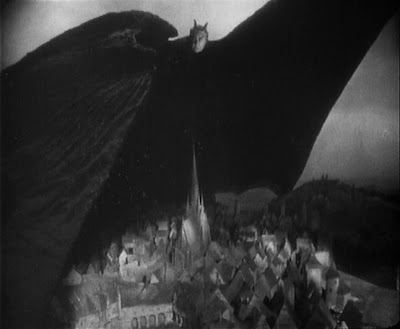
Jannings clearly relished the role of Mephisto, the slow stretching out of his arms later replaced by quicker, more taunting body language when he meets Faust face to face. I've been fascinated by Jannings since familiarizing myself with some of his work. Of the few performances of his I've seen, I see Jannings as always playing not merely a character but some facet of Germany itself. In The Last Laugh, he is the nation's wounded pride, stripped of title and honor in the wake of WWI. In The Blue Angel, he is the nation corrupted by the seedy underbelly of Weimar life. Faust casts him as that corrupting influence, and Jannings plays it up with leering grins and suggestive movements. His portly frame does not preclude his seductive power over all; if Jannings could sing, he'd have made the greatest Don Giovanni of them all. The camera doesn't move that often in Faust, but Jannings is so vibrant and enticing that he makes his frames come alive.
Likewise, Murnau also composes shots that spice up static frames with varied mise-en-scène. In one shot, Faust is brought by a young girl to try to save her plague-ridden mother, who lies motionless in the foreground as the scene changes behind her. The shot holds long enough to create an almost composite effect, the movement of the figures behind the static body nearly resembling a special effect than a simple setup. Of course, actual superimpositions litter the film, with faces alternately mocking or luring characters. The technical detail of Faust is stunning, as is the level of intimacy the film maintains the further it sinks into Faust's corrupting deal with his demon and the slowly constricting ties that bind him.
In fact, despite the disparate subject matter, Faust can be clearly traced to Murnau's subsequent Hollywood feature, Sunrise. Though Faust contains an innate epic quality, Murnau constantly grounds the action with the static shots and the rescaling of Mephisto to human proportions. The two films even share a basic sense of inner conflict, chiefly the simplified juxtaposition of good and evil in romantic terms. The true test of Faust's goodness has nothing to do with his spiritual allegiance but his devotion to Gretchen, the innocent village girl who lures him away from his demonic bacchanal with her pure sweetness.
Amusingly, religion doesn't come out well at all in Faust. As Mephisto's plague rips through the scholar's village, priests and monks appear looking as frenzied and nightmarish as the demon himself. They brandish crosses like swords, damning the dead as wicked simply for having been allowed to expire by the Lord. And when Faust, having freshly sold his soul for the power to save the townsfolk, flinches before a cross, the people he damned himself to save turn on him before he can help a single person. Later, Mephisto, seeking to claim Faust entirely, frames the man for the murder of Gretchen's brother, and Gretchen finds herself ostracized by all. Pregnant with Faust's child, the poor girl finds herself cast out into the wildness by the moralizing authorities, then tried as a murderess when her newborn dies out in the cold. Murnau, a closeted homosexual, must have lost no love for the strict, callous dogma of organized religion. Even so, the flagrant moral equation of the clergy with Mephisto's own devious plotting is shocking for its forthrightness.
The lascivious tone of the film also marks it as being ahead of its time. Given his youth again, Faust's rejuvenated loins are stirred by a vision of a topless woman. Later, as Faust attempts to woo Gretchen, Mephisto intercepts the girl's aunt and seduces her away from monitoring her niece. At one point, the demon even feels up the old woman. The sexualized tone of these moments modernizes the film to fit in the more decadent tenor of Weimar Germany, yet it also seems a more frank and honest depiction of how the centuries-old myth might really have played out.

In effect, such touches make Faust timeless, though sometimes it seems as if all of Murnau's films are divorced from time despite being silents. Equally dark and optimistic, Faust is a glorious farewell to Murnau's homeland, its finale of purifying fire communicating despair and ecstasy in equal amounts. As the magnificent intertitle of the Archangel explains, the final act of salvation is love, nothing more or less. But what the angel himself doesn't seem to realize is that he is therefore useless, and it says something that the light of heaven would soon pale in comparison to the simple act of the sun rising at the end of Murnau's next film. There, love really is all-powerful, unburdened by the chains of European history and God. Perhaps it was the open-ended promise of new beginnings in America that would take Murnau to his fullest expression. That a film this vast should not be his ultimate statement is demonstrative proof of Murnau's almost limitless power.

Modeled chiefly on the first part of Goethe's interpretation of the story, Faust is a film of grandiose darkness. It begins with superimposed images of the four horsemen riding in the clouds, their skeletal figures frozen in grim war poses. Smoke appears in these first shots, as it does in most of the subsequent ones; at times it seems as if hellfire is about to set light to the projector itself. But nothing compares to the sight of Mephisto himself (Emil Jannings), a giant demon revealed in the light of an evil-banishing Archangel. Looking like a mountain with a face, Mephisto is imposing and terrifying even from the torso-up.
Enraged by this purifying light, Mephisto makes a bet with the Archangel. He looks down on a nearby village and shows the angel an aged, wise scholar named Faust (Gösta Ekman). With his flowing beard and philosopher appearance, Faust looks like a Greek, but his Christian faith comes out in the intertitles of his speech. He looks like a paragon of religious scholarship, until Mephisto reveals the man's double life as an alchemist, toiling away in a lab and looking more like Rothwang than Socrates. To further prove his point re: the greed and desire of even the noblest souls, Mephisto bets the Angel that he can win Faust's soul. If he succeeds, the devil shall have dominion of the Earth.
What follows are some of the most incredible sights in Murnau's canon. Using a model village, Murnau makes Jannings look positively gargantuan in long shot, his already large features exploded beyond all reason. Clearly the inspiration for the best sequence of Fantasia, the scene of Mephisto stretching his wings out over the village, blocking out the sun and issuing a billowing fog of Black Death, is masterful in its sinister power. It's the largest, most bombastic moment of the film, and it happens early. But when the demon shrinks down to tempt Faust with the power to cure this plague, it's to Murnau's (and Jannings') credit that the movie feels no less large and operatic.

Jannings clearly relished the role of Mephisto, the slow stretching out of his arms later replaced by quicker, more taunting body language when he meets Faust face to face. I've been fascinated by Jannings since familiarizing myself with some of his work. Of the few performances of his I've seen, I see Jannings as always playing not merely a character but some facet of Germany itself. In The Last Laugh, he is the nation's wounded pride, stripped of title and honor in the wake of WWI. In The Blue Angel, he is the nation corrupted by the seedy underbelly of Weimar life. Faust casts him as that corrupting influence, and Jannings plays it up with leering grins and suggestive movements. His portly frame does not preclude his seductive power over all; if Jannings could sing, he'd have made the greatest Don Giovanni of them all. The camera doesn't move that often in Faust, but Jannings is so vibrant and enticing that he makes his frames come alive.
Likewise, Murnau also composes shots that spice up static frames with varied mise-en-scène. In one shot, Faust is brought by a young girl to try to save her plague-ridden mother, who lies motionless in the foreground as the scene changes behind her. The shot holds long enough to create an almost composite effect, the movement of the figures behind the static body nearly resembling a special effect than a simple setup. Of course, actual superimpositions litter the film, with faces alternately mocking or luring characters. The technical detail of Faust is stunning, as is the level of intimacy the film maintains the further it sinks into Faust's corrupting deal with his demon and the slowly constricting ties that bind him.
In fact, despite the disparate subject matter, Faust can be clearly traced to Murnau's subsequent Hollywood feature, Sunrise. Though Faust contains an innate epic quality, Murnau constantly grounds the action with the static shots and the rescaling of Mephisto to human proportions. The two films even share a basic sense of inner conflict, chiefly the simplified juxtaposition of good and evil in romantic terms. The true test of Faust's goodness has nothing to do with his spiritual allegiance but his devotion to Gretchen, the innocent village girl who lures him away from his demonic bacchanal with her pure sweetness.
Amusingly, religion doesn't come out well at all in Faust. As Mephisto's plague rips through the scholar's village, priests and monks appear looking as frenzied and nightmarish as the demon himself. They brandish crosses like swords, damning the dead as wicked simply for having been allowed to expire by the Lord. And when Faust, having freshly sold his soul for the power to save the townsfolk, flinches before a cross, the people he damned himself to save turn on him before he can help a single person. Later, Mephisto, seeking to claim Faust entirely, frames the man for the murder of Gretchen's brother, and Gretchen finds herself ostracized by all. Pregnant with Faust's child, the poor girl finds herself cast out into the wildness by the moralizing authorities, then tried as a murderess when her newborn dies out in the cold. Murnau, a closeted homosexual, must have lost no love for the strict, callous dogma of organized religion. Even so, the flagrant moral equation of the clergy with Mephisto's own devious plotting is shocking for its forthrightness.
The lascivious tone of the film also marks it as being ahead of its time. Given his youth again, Faust's rejuvenated loins are stirred by a vision of a topless woman. Later, as Faust attempts to woo Gretchen, Mephisto intercepts the girl's aunt and seduces her away from monitoring her niece. At one point, the demon even feels up the old woman. The sexualized tone of these moments modernizes the film to fit in the more decadent tenor of Weimar Germany, yet it also seems a more frank and honest depiction of how the centuries-old myth might really have played out.

In effect, such touches make Faust timeless, though sometimes it seems as if all of Murnau's films are divorced from time despite being silents. Equally dark and optimistic, Faust is a glorious farewell to Murnau's homeland, its finale of purifying fire communicating despair and ecstasy in equal amounts. As the magnificent intertitle of the Archangel explains, the final act of salvation is love, nothing more or less. But what the angel himself doesn't seem to realize is that he is therefore useless, and it says something that the light of heaven would soon pale in comparison to the simple act of the sun rising at the end of Murnau's next film. There, love really is all-powerful, unburdened by the chains of European history and God. Perhaps it was the open-ended promise of new beginnings in America that would take Murnau to his fullest expression. That a film this vast should not be his ultimate statement is demonstrative proof of Murnau's almost limitless power.
Tuesday, January 31
Shanghai Express (Josef von Sternberg, 1932)
[This is my first post for my Blind Spots 2012 choices]
 Previously familiar with the legendary pair of Josef von Sternberg and muse Marlene Dietrich only from The Blue Angel, I got a much better grasp of what made the two such a fantastic duo from Shanghai Express, the fourth of their seven collaborations. Set on a train traveling from Beiping to Shanghai during the Chinese Civil War, Shanghai Express serves not only as a showcase for von Sternberg's formal mastery—Dietrich attributes the Oscar-winning cinematography mostly to him—but for what makes director and star such a good match. It's also such an advanced, nuanced drama that its chiaroscuro textures and layered, repressed emotions would not be so beautifully evoked in another picture until Only Angels Have Wings at the end of the decade.
As with Howard Hawks' masterpiece, Shanghai Express (written by future Big Sleep screenwriter with uncredited help from Hawks himself) opens in an exotic location so bustling with activity that its exoticism is defined less by the setting than the menagerie of people wading through it. A cast of characters from different nationalities and temperaments get their train tickets and fight through the crowds to get on-board before departure. Terse, meaty dialogue exchanged between people dances around sexual lines without leaving much to the imagination, as the presence of certain kinds of women set some passengers on edge and generate intense excitement for the rest.
One of those women is Shanghai Lily (Dietrich), a "coaster" whose reputation precedes her. When word gets out that she may be on the train, most of the men can scarcely contain their lust, and even the perpetually offended missionary sounds, at the very least, intrigued. But when a British military doctor, Captain Harvey (Clive Brook), stumbles across the be-boaed, veiled minx, he recognizes Lily as Magdalen. Dietrich's hard features do not react to this unexpected reunion, though even her wry smirk cannot fully mask the shock of seeing this man again, much less being called her old name.
The heated lines passed between Harvey and Lily reveal a broken romance spurned by her actions, a loyalty test that backfired and drove the doctor away in offense. But to look at Lily now, the thought of her being so sentimental as to try her lover's dedication is almost incomprehensible. Her flippant, seductive tone of voice carries through the entire film, even at her most honest and selfless. Dietrich displays here a singular ability to be unmistakably human and sentimental without betraying an ounce of softness. To the audience, Lily's lingering love for Harvey is impossible to miss, but she's so hard and unflinching even under her already imposing exterior that one can forgive the doctor for not seeing her true feelings.
This burial of melodramatic, theatrical emotion under layers of carefully ordered, objectively removed dressing meshes beautifully with von Sternberg's camera style. Shanghai Express, made during the gritty punchiness of the Pre-Code era, reflects that time period in its punchy dialogue and indirectly direct sex talk, but the director's visual elegance far outstrips his peers. Like any great train movie, Shanghai Express generates a constantly shifting backdrop organized by rigidly static, even claustrophobically narrow and unchanging, mise-en-scène. Chiaroscuro lighting casts what would otherwise be a romantic drama as a borderline thriller of moral ambiguity and hidden despair, a pre-noir underworld of false fronts and swift judgments. The world outside the train is an ever-changing nightmare of building tensions, steam swirling around silhouetted railroad workers and a gradually mounting rebel presence that slowly encroaches on the already unstable peace among the eclectic passengers.
The danger finally mounts to the point that it penetrates the insular realm of the train, and von Sternberg's alteration of lighting and shot placements completely change the tone of the familiar interior sets. Character dynamics also get overhauled, with the revelation of a rebel among the passengers and reevaluations of people by the others. The other courtesan traveling on board, played by a fierce Anna May Wong, becomes intense with patriotic fervor when she realizes Chang is the wanted warlord, speaking coldly of his offenses to China. The judgmental missionary who refused to even sit in a cabin with these loose women comes to view Lily in a different light, and he even finds himself defending her to the others when the gossipy nature of the other passengers boils over.
But the act that turns the missionary's opinion of Lily is not so much a different side of the woman so much as the first good glance of her real self. She nearly sacrifices herself for Harvey, who is still so adamantly clueless that he does not realize what he gets himself into by disrespecting the warlord and how brave Lily is to volunteer her services to save her true love. The tragedy of his ignorant dismissal endures even past the seeming resolution of the perilous situation, as Lily makes plain her love for Harvey while not delving into the full extent of her sacrifice, at this point unable to be open with herself, much less others. A flippant Harvey notes that Lily is trembling when they talk after being rescued from Chang, to which she says, "It's because you...touched me, Doc." Dietrich utters this response with a tossed-off, even playful bite, a come-hither tease that permits her to openly state how she feels while still hiding behind her armor. But when von Sternberg frames Dietrich in a highly stylized, shadowed medium close-up after she leaves his cabin, leaning against the door and trembling so violently she can barely get her cigarette to her lips, the full extent of her devastation engulfs the screen.
Shanghai Express ends on conventional terms in a general sense, but there is a surprisingly modern willingness to accept one's partner for who they are, as opposed to what one wishes the other should be. Refreshingly, Shanghai Express is not about the redemption of a whore; in fact, the two most heroic people in the movie are both courtesans and both act out their bravery through their seductive powers. But the real delight remains that train ride, so locked into its path—in physical and literary terms—yet so routinely reinventing and fresh. I cannot think of a train movie to rival it until Wes Anderson made his even more ruminative The Darjeeling Limited, another film that dismantles preconceived notions of people as privileged whites ride through a troubled, foreign, complex land. And Shanghai Express doesn't even have such lofty ambitions; it primarily serves to show off von Sternberg's formal skill and Dietrich's unique acting chops. But as they say, when you've got it, flaunt it.

As with Howard Hawks' masterpiece, Shanghai Express (written by future Big Sleep screenwriter with uncredited help from Hawks himself) opens in an exotic location so bustling with activity that its exoticism is defined less by the setting than the menagerie of people wading through it. A cast of characters from different nationalities and temperaments get their train tickets and fight through the crowds to get on-board before departure. Terse, meaty dialogue exchanged between people dances around sexual lines without leaving much to the imagination, as the presence of certain kinds of women set some passengers on edge and generate intense excitement for the rest.
One of those women is Shanghai Lily (Dietrich), a "coaster" whose reputation precedes her. When word gets out that she may be on the train, most of the men can scarcely contain their lust, and even the perpetually offended missionary sounds, at the very least, intrigued. But when a British military doctor, Captain Harvey (Clive Brook), stumbles across the be-boaed, veiled minx, he recognizes Lily as Magdalen. Dietrich's hard features do not react to this unexpected reunion, though even her wry smirk cannot fully mask the shock of seeing this man again, much less being called her old name.
The heated lines passed between Harvey and Lily reveal a broken romance spurned by her actions, a loyalty test that backfired and drove the doctor away in offense. But to look at Lily now, the thought of her being so sentimental as to try her lover's dedication is almost incomprehensible. Her flippant, seductive tone of voice carries through the entire film, even at her most honest and selfless. Dietrich displays here a singular ability to be unmistakably human and sentimental without betraying an ounce of softness. To the audience, Lily's lingering love for Harvey is impossible to miss, but she's so hard and unflinching even under her already imposing exterior that one can forgive the doctor for not seeing her true feelings.
This burial of melodramatic, theatrical emotion under layers of carefully ordered, objectively removed dressing meshes beautifully with von Sternberg's camera style. Shanghai Express, made during the gritty punchiness of the Pre-Code era, reflects that time period in its punchy dialogue and indirectly direct sex talk, but the director's visual elegance far outstrips his peers. Like any great train movie, Shanghai Express generates a constantly shifting backdrop organized by rigidly static, even claustrophobically narrow and unchanging, mise-en-scène. Chiaroscuro lighting casts what would otherwise be a romantic drama as a borderline thriller of moral ambiguity and hidden despair, a pre-noir underworld of false fronts and swift judgments. The world outside the train is an ever-changing nightmare of building tensions, steam swirling around silhouetted railroad workers and a gradually mounting rebel presence that slowly encroaches on the already unstable peace among the eclectic passengers.
The danger finally mounts to the point that it penetrates the insular realm of the train, and von Sternberg's alteration of lighting and shot placements completely change the tone of the familiar interior sets. Character dynamics also get overhauled, with the revelation of a rebel among the passengers and reevaluations of people by the others. The other courtesan traveling on board, played by a fierce Anna May Wong, becomes intense with patriotic fervor when she realizes Chang is the wanted warlord, speaking coldly of his offenses to China. The judgmental missionary who refused to even sit in a cabin with these loose women comes to view Lily in a different light, and he even finds himself defending her to the others when the gossipy nature of the other passengers boils over.
But the act that turns the missionary's opinion of Lily is not so much a different side of the woman so much as the first good glance of her real self. She nearly sacrifices herself for Harvey, who is still so adamantly clueless that he does not realize what he gets himself into by disrespecting the warlord and how brave Lily is to volunteer her services to save her true love. The tragedy of his ignorant dismissal endures even past the seeming resolution of the perilous situation, as Lily makes plain her love for Harvey while not delving into the full extent of her sacrifice, at this point unable to be open with herself, much less others. A flippant Harvey notes that Lily is trembling when they talk after being rescued from Chang, to which she says, "It's because you...touched me, Doc." Dietrich utters this response with a tossed-off, even playful bite, a come-hither tease that permits her to openly state how she feels while still hiding behind her armor. But when von Sternberg frames Dietrich in a highly stylized, shadowed medium close-up after she leaves his cabin, leaning against the door and trembling so violently she can barely get her cigarette to her lips, the full extent of her devastation engulfs the screen.
Shanghai Express ends on conventional terms in a general sense, but there is a surprisingly modern willingness to accept one's partner for who they are, as opposed to what one wishes the other should be. Refreshingly, Shanghai Express is not about the redemption of a whore; in fact, the two most heroic people in the movie are both courtesans and both act out their bravery through their seductive powers. But the real delight remains that train ride, so locked into its path—in physical and literary terms—yet so routinely reinventing and fresh. I cannot think of a train movie to rival it until Wes Anderson made his even more ruminative The Darjeeling Limited, another film that dismantles preconceived notions of people as privileged whites ride through a troubled, foreign, complex land. And Shanghai Express doesn't even have such lofty ambitions; it primarily serves to show off von Sternberg's formal skill and Dietrich's unique acting chops. But as they say, when you've got it, flaunt it.
Monday, January 2
Blind Spots 2012
So, various bloggers I read and like have decided to address various, wait for it, blind spots in their movie viewing in 2012. I consider much of my blog writing an attempt to fill various gaps in knowledge, but I love a good writing meme, and considering how many "must-sees" end up falling through the cracks as I get distracted with other things, perhaps listing 12 here (one per month) will at least commit me to watching some of the movies I tell myself I must see with all haste.
Actress [a.k.a. Centre Stage] (Stanely Kwan, 1992)
I love me some Maggie Cheung, and this film sports what, as far as I've seen, is her most lauded performance. Based on the tragically short life of '30s Chinese film star Ruan Lingyu (whose own seminal film The Goddess I also need to see), Actress got plenty of plaudits, the most prominent of which was Jonathan Rosenbaum listing it among the best films of the '90s.
L'argent (Robert Bresson, 1983)
A) It's Robert Bresson, thus necessitating I see it. B) It's on damn near every serious list of the best films of the '80s, a decade I'm still slowly mapping, cinema-wise.
The Best Years of Our Lives (William Wyler, 1946)
I believe it was on Twitter that the Self-Styled Siren (probably the best film writer in the country at the moment) argued for the underrating of William Wyler, furthermore arguing that this movie was the best Best Picture winner ever. I think she meant that literally, but I also got the sense she was speaking in terms of the mental image of a Best Picture winner, a.k.a. a typically middlebrow, easily digestible affair. But if the Siren sees artistry in it, you can be damn sure it's there, and I love the handful of Wylers I've seen.
Birth (Jonathan Glazer, 2004)
Comparisons to Kubrick and a celebrated score by my favorite modern film composer, Alexandre Desplat. I have neglected this for far too long.
Don't Look Now (Nicolas Roeg, 1973)
Supposedly one of the most unsettling films ever made. Given my preference for horror in the Repulsion vein of disruption and disturbance over jump scares, Nic Roeg's movie should be for me.
Faust (F.W. Murnau, 1926)
This has just been a major oversight I've sought to correct for a while. Murnau was perhaps the first poet of the cinema, and I've been looking forward to completing my gaps in his filmography.
Irma Vep (Olivier Assayas, 1996)
Another film starring Maggie Cheung, this one by one of my favorite modern directors, Olivier Assayas, and drawing its subject matter at least partially from the director of the next film on my list...
Judex (Louis Feuillade, 1916)
I've only seen short films by Feuillade and found them to be incredible, the perfect balance between Méliès' fantasy and the Lumières' flat documentation. I'd therefore like to check out one of his serials, and I think I'll start with this one, though Les Vampires and the Fantômas series are also priorities.
The Long Day Closes (Terence Davies, 1992)
Davies Distant Voices, Still Lives is a masterpiece, and this sequel seems to get about as much praise. I figured I'd watch this in anticipation of Davies' new film, The Deep Blue Sea, which toured the festival circuit last year but has yet to get wider release in the States.
Shanghai Express (Josef von Sternberg, 1932)
The only von Sternberg/Dietrich collaboration I've seen is The Blue Angel, but I have it on good authority from several that this commercially unavailable pairing brings out the best in both of them. Considering how great The Blue Angel is, I can't wait.
Some Came Running (Vincente Minnelli, 1958)
I am deeply ashamed to admit I've never seen any Minnelli film, a problem I hope to rectify in the coming days with my new Blu-Ray of his Meet Me in St. Louis. But while the rest of his acclaimed musicals are also on my to-watch list, I must finally stop neglecting to see this drama, praised to the high heavens by damn near everyone I know and follow who's seen it.
There's Always Tomorrow (Douglas Sirk, 1956)
Douglas Sirk, maker of hyperstylized Technicolor films, also made equally artistic black and white films, or so I'm told of his four monochrome features. I can't remember where I saw a rave for this but it made me more eager to watch it than even Sirk's Faulkner adaptation The Tarnished Angels, which I may also get around to this year.


