Benardo Bertolucci's The Last Emperor offers no sense of comfort for its titular subject. Its present, set in a post-Mao China, is cast in pallid grays, a deathly sense of decay and necrosis emanating from its shots of soldiers lined up to take war criminals off a train and transfer them to an old prison. However, its first flashback, of the deposed emperor ascending the throne as a child, swaps out the drabness for soft yellow tones so warm they become suffocating. Communist China may hold no quarter for the last emperor, but the sheltered, obsolete world into which Pu Yi comes to briefly rule is just as incompatible for a child of the 20th century.
Made with an unprecedented level of cooperation by the Chinese government, The Last Emperor provides a mournful microcosm for the upheaval of the early 20th century. Still a toddler afraid to be separated from his mother and bonded with his wet nurse, Pu Yi is suddenly a god to the eunuchs and concubines, who must treat this child as such even as they attempt to handle his age-appropriate tempers and playfulness. But his status as a supreme being only truly applies to the walls of the vast but finite palace in which he lives. The film's first half remains within the Forbidden City until its gargantuan size feels claustrophobic, the sounds of rapid social change in surrounding Peking buzzing with inevitability. Eventually that world will shatter Pu Yi's own, allowing Bertolucci to fully explore his passion for national and sexual politics as the emperor, like China itself, makes up for centuries of static social systems with tumultuous changes in a short period of time.
Bertolucci's graceful camera, aided by the gorgeous cinematography of longtime collaborator Vittorio Storaro, captures Pu Yi's childhood with a clear sense of irony. The selfish toddler does not fully understand his role, only that it means he can do whatever he wants, and it's amusing to see his handlers trying to calm the rambunctious child down without be able to make any kind of physical contact or issue any command—who, after all, can order around an emperor? Yet forces still restrict the child, especially the old courtesans who gather in Pu Yi's vicinity but never quite his presence—they typically not not share a shot with the emperor, and when they do they are separated by some kind of frame, which only makes them further resemble living portraits of long-dead, long-outdated ancestral voices. When the women see the ties between Pu Yi and his wet nurse lingering for too long, they expel the woman. And while the boy continues to play around the palace, those in charge of handling his affairs give up his royal authority in the wake of nationalist rebellions. As an adviser sadly informs the child, he remains emperor inside the Forbidden City, "but not outside."
By intercutting between the palace and the internment center, Bertolucci demonstrates that the emperor has only ever really known prison. The only difference between the Forbidden City and the center in Fushun is that his captors in the former pretended to obey him while scheming and plotting in the real world, while at least the Maoist wardens and guards treat him directly. And as much as John Lone's face communicates anguish and shame as the adult Pu Yi, it also contains traces of contentment, even relief, not seen in the character's younger incarnations. Here he is finally just another person, which is what he wanted all along, even when he recoiled at the first tastes of that commonality.
But there is still a 40-year gap between these early flashbacks and the present, and Bertolucci uses the details of Pu Yi's life in the intervening years to clarify the forces at work on the Chinese mindset. As the emperor, the lad is already at a disadvantage, even more backward than his peasants. Trapped in the one place where he can still behave as a monarch, Pu Yi belatedly Westernizes, ignorant of the ravages of Western influence on his empire. His people are already flirting with the Reds in Russia, and by the time Japan offers him puppet rule of Manchuria, he's out of step with the nationalist movement that resists the takeover. Even the Scottish tutor who becomes a trusted friend (Peter O'Toole) recognizes how behind the emperor is, though he only voices his concerns to the other advisers. Pu Yi never can catch up, and his attempts to modernize only alienate him from everyone.
That separation carries over to the man's sexual life, which is at once woefully outdated and more open than modern couples can enjoy. While in a port city just before his faux-reascension, Pu Yi and his two wives mingle at a party, where one of the women dances with an American and tells him that she is "wife number two." The American, so brash and flirtatious, blanches at this information, barely able to stammer out a, "Some guys have all the luck." But Pu Yi did not really get to choose either, and his consort was actually his pick for the handful of politically rewarding options given to him (his second choice was more fortuitous, hence her being the empress). Likewise, his wives begin to chafe after the expulsion from the Forbidden City, forced to deal not merely with the loss of station but the sudden meaninglessness of their designations. Bertolucci tied sex to power with The Conformist, which mingled homosexuality and fascism, and Pu Yi's lack of power—and subsequently hollow "reascension"—seem to completely kill his sex drive, while the women find more extreme ways to cope.
Nevertheless, for the clear sympathy the director shows to his subject, Bertolucci subverts the emperor's perception of his real tribulations. The aforementioned suffocation of the Forbidden City makes his omnipotence within its walls ironic, and his dealings with the Japanese are no better. In fact, a shot changes color tones when his handlers calmly but forcibly set Pu Yi straight on the farce of his rule of Manchukuo, the frame turning an icy blue-white. Bertolucci, an acknowledged Marxist, does not cover up the violence and subjugation of Communist China—he pointedly links the coded discipline of those within the Forbidden City to that of the soldiers taking political prisoners—but he does suggest a beneficial side effect. After his "successful" conversion to Communist ideals in the holding center, Pu Yi is released a decade later, and when we see him at the end, he seems to have found some measure of contentment. He even identifies himself as a gardener to a soldier, his past life as a monarch totally behind him. Unmistakable is the implication that the former is more meaningful and fulfilling than the latter.
|
|
|
|
|
Home » Posts filed under Peter O'Toole
Showing posts with label Peter O'Toole. Show all posts
Saturday, December 3
Wednesday, September 7
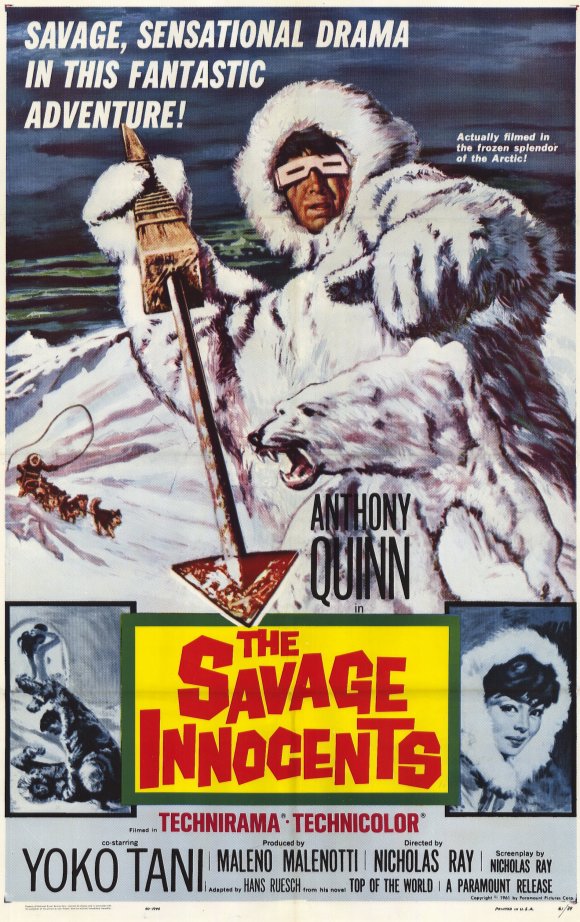
The Savage Innocents (Nicholas Ray, 1960)
[The following is a contribution to the Nicholas Ray Blog-A-Thon for Tony Dayoub's Cinema Viewfinder.]
Shot partially on location in the Arctic, The Savage Innocents switches the familiar expanse of the West for the bleached tundra of the North. Where the heroes of the West stand as moral individualists, carving out their space in the seeming infinity of the range, the protagonist of the Arctic must fight not for his moral authority but mere survival. Its title speaks to the contrast of Inuit life between the innocence of such life and the savagery needed to stay alive. This is embodied in the first shots, of two Inuits throwing real spears into a real polar bear, puncturing the poor beast as blood pours out into the icy water in which it swims. The Eskimos simply need to eat, but the sight of a bear being stabbed to death is gruesome, especially in the age of close animal monitoring and CGI slaughters in the movies.
Yet Ray's film depicts not so much a Manichean contrast as a coexistence of the irreconcilable traits of humanity. By filtering that humanity through the customs of a non-Western race—some of them true, some of them not, all of that beside the point—Ray divorces the audience from its sense of normalcy to show the contradictory nature of culture and its inexplicability to those of another civilization. Granted, the inaccuracies and ignorance that pepper The Savage Innocents (to say nothing of the casting of not one Inuit in a part) hinder the film to a significant degree, but Ray's overriding point is the same one of all his films: the homes we make and who we make them with. Riddled with dated elements, The Savage Innocents nevertheless finds yet another angle from which Ray can attack his central preoccupations. And if his depiction of Inuits occasionally sends the eyes darting down from the screen to look at the embarrassment, that shame should also come from the realization that this thoroughly non-idealized portrait of another culture is more interested in the true behavior of a different race than nearly any Hollywood movie before or since.
The hero of the film, though played by the white, 45-year-old Anthony Quinn, is an almost childlike Inuit named Inuk. We get a taste for different cultures almost instantly when Inuk returns to the home of his friend, Anarwik, to find the man and his wife "laughing," as they say euphemistically. Rather than excuse himself with embarrassment, Inuk chats with the two, who talk right back as if nothing could be more common. Anarwik even offers to let Inuk "laugh" with his wife and takes extreme offense when Inuk old-fashionably (to our eyes, at least) turns him down, prompting a violent argument. For Ray to so casually introduce the idea of wife-sharing and polyamorous relationships into his film marks an open break from the system of values he had to uphold and only tacitly subvert in Hollywood. And while the film often feels like an old studio feature, with its racial miscasting and awkward transitions between studio sets and location shots, this defiant approach to sex and tangible violence (in both the animal killing and nonjudgmental physicality between characters) shows unmistakable defiance of Ray's old professional home.
If Ray used his old films to dive under the gloss of suburban, urban and Old Western values, here he takes direct aim at the Establishment. Apart from the sexual liberation of his non-Western characters (including some nudity), Ray also mocks the the emphasis placed on technology, capitalism and God. Inuk's innocence is on its purest display in his quest for a wife, even if he does threaten to kill a rival suitor for the woman he wants before deciding to settle for her sister. But when he and his new bride, Asiak, go hunting a polar bear, their long, traditional method of wearing down the beast abruptly cut short with the crack of a rifle, a thunderclap so unexpected after 40 minutes of tribal leaving that Inuk's own bewilderment and fright may well match the audience's own. Now Inuk gets introduced to the white culture through the technology of its weaponry; when white people actually show up this movie, they don't do themselves much more credit than their insidious invention.
The fellow Inuit who owns the gun points Inuk in the direction of a white trading post where he might be able to get a rifle of his own for 100 fox skins. This capitalist enterprise, ruinous to the ecosystem and clearly exploitative (no way the worth of the gun remotely stacks up to the fortune a white trader could make back home with that many pelts), is seen as vile and corrupting. The Inuits who populate the trading post are so Westernized that they laugh louder than the whites when Inuk and Asiak wander in with their bearskin clothes. The presence of money has already made these young people forget their cultures.
Lest Ray stop there, however, he moves beyond capitalism to deride the other staple of conservative American values: Jesus. A missionary follows Inuk and Asiak home to proselytize, but the Inuits do not understand the message. Their practical responses to the matters of faith—such as Asiak griping that this Jesus fellow better bring his own sled if he's going to be in their lives—is funny, but it reveals a simple truth: for people who fight every day to stay alive, the words of a man dead 2,000 years are meaningless. The man refuses the Inuit offers of old meat and wife-sharing, enraging the already irritated Inuk into inadvertently bashing the man's head in in offense. The missionary does not understand the Eskimos' values because he has been raised to consider Christianity to be a universal. His refusal of the spoiled meat and Asiak is immediate and fervent, not mean-spirited but borne of his sense of what is right. He does not explain his cultural perspective because he assumes it is the right one, and for that he pays dearly.
The film's final act follows the manhunt for Inuk by two white Mounties (including Peter O'Toole in his feature debut, though he demanded to be removed from the credits after his voice was overdubbed). These are not bad men, merely following their duty in bringing a murderer to justice. But when they catch up to Inuk, the ridiculousness of their cultural values being used on someone outside that system becomes evident in short order. But seeing the endpoint of one's cultural reach is not an easy thing to face, and O'Toole's trooper literally collapses from the strain of seeing everything he holds to be true nearly get him killed for nothing in a land where his perspective does not apply. Even his shows of kindness mean little, and for a film with so much misunderstanding of Inuit culture and the whitewash of the lead casting, I was pleasantly surprised to see this wasn't a film where the white man intervened on a minority's behalf. Quite the opposite: Inuk, without stating any message, asserts his hard-won dominance of his patch of ice, and though O'Toole says he's letting the man go, it's clear he's only doing so to save face. Inuk is the one sending the trooper on his way.
These thematic elements are only bolstered by Aldo Tonti's magnificent Technicolor 70mm photography. Graceful, swift tracks follow Inuits kayaking, and Ray captures the Arctic in its static beauty, the ice mingling with the pale blue of the sky until only the crags of glaciers delineate land and air. There are even surreal sights, like the shot of O'Toole's partner freezing to death after falling into water, his face frosting over in seconds as O'Toole pathetically tries to help.
Even if we accept the use of Inuit culture as a front for lobbing mortars into American values, The Savage Innocents still has a few too many absurdities (whether genuinely considered true at the time or not) to entirely forgive. The thought that an Inuit couple would be reduced to fears of angry spirits at the arrival of a new baby because they don't understand babies are born without teeth is just offensive. Nevertheless, The Savage Innocents holds up in many ways: as a redoubled effort in Ray's ongoing war with social and aesthetic conservatism, as a romanticized but often realistic view of another culture through its own prism, and as mournful view of a dying culture. Speaking of Inuk, Asiak and Asiak's mother, a white trader notes to a mocking friend, "Ten years ago, nearly all the Eskimos were like those three. Magnificent." If nearly all of Ray's protagonists reflect some aspect of the man himself, then this Inuit, a creature splintered off from the development of his long-removed Western kin, exhibits the director's full break from the system. Though he would take two more projects before his mental collapse, this film announced Ray would never be the same, and indeed he never was, not even in the mainstream (on the surface, at any rate) Biblical epic he would tackle next.
Shot partially on location in the Arctic, The Savage Innocents switches the familiar expanse of the West for the bleached tundra of the North. Where the heroes of the West stand as moral individualists, carving out their space in the seeming infinity of the range, the protagonist of the Arctic must fight not for his moral authority but mere survival. Its title speaks to the contrast of Inuit life between the innocence of such life and the savagery needed to stay alive. This is embodied in the first shots, of two Inuits throwing real spears into a real polar bear, puncturing the poor beast as blood pours out into the icy water in which it swims. The Eskimos simply need to eat, but the sight of a bear being stabbed to death is gruesome, especially in the age of close animal monitoring and CGI slaughters in the movies.
Yet Ray's film depicts not so much a Manichean contrast as a coexistence of the irreconcilable traits of humanity. By filtering that humanity through the customs of a non-Western race—some of them true, some of them not, all of that beside the point—Ray divorces the audience from its sense of normalcy to show the contradictory nature of culture and its inexplicability to those of another civilization. Granted, the inaccuracies and ignorance that pepper The Savage Innocents (to say nothing of the casting of not one Inuit in a part) hinder the film to a significant degree, but Ray's overriding point is the same one of all his films: the homes we make and who we make them with. Riddled with dated elements, The Savage Innocents nevertheless finds yet another angle from which Ray can attack his central preoccupations. And if his depiction of Inuits occasionally sends the eyes darting down from the screen to look at the embarrassment, that shame should also come from the realization that this thoroughly non-idealized portrait of another culture is more interested in the true behavior of a different race than nearly any Hollywood movie before or since.
The hero of the film, though played by the white, 45-year-old Anthony Quinn, is an almost childlike Inuit named Inuk. We get a taste for different cultures almost instantly when Inuk returns to the home of his friend, Anarwik, to find the man and his wife "laughing," as they say euphemistically. Rather than excuse himself with embarrassment, Inuk chats with the two, who talk right back as if nothing could be more common. Anarwik even offers to let Inuk "laugh" with his wife and takes extreme offense when Inuk old-fashionably (to our eyes, at least) turns him down, prompting a violent argument. For Ray to so casually introduce the idea of wife-sharing and polyamorous relationships into his film marks an open break from the system of values he had to uphold and only tacitly subvert in Hollywood. And while the film often feels like an old studio feature, with its racial miscasting and awkward transitions between studio sets and location shots, this defiant approach to sex and tangible violence (in both the animal killing and nonjudgmental physicality between characters) shows unmistakable defiance of Ray's old professional home.
If Ray used his old films to dive under the gloss of suburban, urban and Old Western values, here he takes direct aim at the Establishment. Apart from the sexual liberation of his non-Western characters (including some nudity), Ray also mocks the the emphasis placed on technology, capitalism and God. Inuk's innocence is on its purest display in his quest for a wife, even if he does threaten to kill a rival suitor for the woman he wants before deciding to settle for her sister. But when he and his new bride, Asiak, go hunting a polar bear, their long, traditional method of wearing down the beast abruptly cut short with the crack of a rifle, a thunderclap so unexpected after 40 minutes of tribal leaving that Inuk's own bewilderment and fright may well match the audience's own. Now Inuk gets introduced to the white culture through the technology of its weaponry; when white people actually show up this movie, they don't do themselves much more credit than their insidious invention.
The fellow Inuit who owns the gun points Inuk in the direction of a white trading post where he might be able to get a rifle of his own for 100 fox skins. This capitalist enterprise, ruinous to the ecosystem and clearly exploitative (no way the worth of the gun remotely stacks up to the fortune a white trader could make back home with that many pelts), is seen as vile and corrupting. The Inuits who populate the trading post are so Westernized that they laugh louder than the whites when Inuk and Asiak wander in with their bearskin clothes. The presence of money has already made these young people forget their cultures.
Lest Ray stop there, however, he moves beyond capitalism to deride the other staple of conservative American values: Jesus. A missionary follows Inuk and Asiak home to proselytize, but the Inuits do not understand the message. Their practical responses to the matters of faith—such as Asiak griping that this Jesus fellow better bring his own sled if he's going to be in their lives—is funny, but it reveals a simple truth: for people who fight every day to stay alive, the words of a man dead 2,000 years are meaningless. The man refuses the Inuit offers of old meat and wife-sharing, enraging the already irritated Inuk into inadvertently bashing the man's head in in offense. The missionary does not understand the Eskimos' values because he has been raised to consider Christianity to be a universal. His refusal of the spoiled meat and Asiak is immediate and fervent, not mean-spirited but borne of his sense of what is right. He does not explain his cultural perspective because he assumes it is the right one, and for that he pays dearly.
The film's final act follows the manhunt for Inuk by two white Mounties (including Peter O'Toole in his feature debut, though he demanded to be removed from the credits after his voice was overdubbed). These are not bad men, merely following their duty in bringing a murderer to justice. But when they catch up to Inuk, the ridiculousness of their cultural values being used on someone outside that system becomes evident in short order. But seeing the endpoint of one's cultural reach is not an easy thing to face, and O'Toole's trooper literally collapses from the strain of seeing everything he holds to be true nearly get him killed for nothing in a land where his perspective does not apply. Even his shows of kindness mean little, and for a film with so much misunderstanding of Inuit culture and the whitewash of the lead casting, I was pleasantly surprised to see this wasn't a film where the white man intervened on a minority's behalf. Quite the opposite: Inuk, without stating any message, asserts his hard-won dominance of his patch of ice, and though O'Toole says he's letting the man go, it's clear he's only doing so to save face. Inuk is the one sending the trooper on his way.
These thematic elements are only bolstered by Aldo Tonti's magnificent Technicolor 70mm photography. Graceful, swift tracks follow Inuits kayaking, and Ray captures the Arctic in its static beauty, the ice mingling with the pale blue of the sky until only the crags of glaciers delineate land and air. There are even surreal sights, like the shot of O'Toole's partner freezing to death after falling into water, his face frosting over in seconds as O'Toole pathetically tries to help.
Even if we accept the use of Inuit culture as a front for lobbing mortars into American values, The Savage Innocents still has a few too many absurdities (whether genuinely considered true at the time or not) to entirely forgive. The thought that an Inuit couple would be reduced to fears of angry spirits at the arrival of a new baby because they don't understand babies are born without teeth is just offensive. Nevertheless, The Savage Innocents holds up in many ways: as a redoubled effort in Ray's ongoing war with social and aesthetic conservatism, as a romanticized but often realistic view of another culture through its own prism, and as mournful view of a dying culture. Speaking of Inuk, Asiak and Asiak's mother, a white trader notes to a mocking friend, "Ten years ago, nearly all the Eskimos were like those three. Magnificent." If nearly all of Ray's protagonists reflect some aspect of the man himself, then this Inuit, a creature splintered off from the development of his long-removed Western kin, exhibits the director's full break from the system. Though he would take two more projects before his mental collapse, this film announced Ray would never be the same, and indeed he never was, not even in the mainstream (on the surface, at any rate) Biblical epic he would tackle next.


